Proxy Location Checker
This proxy location checker takes an IP address or a proxy line copied from your dashboard. For a proxy, we open one connection through it and read the exit IP. Then ipinfo.io and six other geolocation databases say where that IP is: country, region, city and network, side by side, each with a link to verify it.
- Seven databases side by side
- An IP or a full proxy line
- IPv4 and IPv6
Check where an IP is
The password is used for this one connection, then dropped. It is never stored, logged or sent back. Free: 40 checks a day, 15 of them proxy tests.
How to read the result
Each row is one database's answer for the same IP. The line above the table sums them up against ipinfo.io.
- Every row shows the same country. The location is settled: any site that reads one of these databases shows that country.
- ipinfo.io and most rows agree, one or two differ. Common. The outliers have older or different data for that range, and the sites that read them show the other country.
- ipinfo.io stands against most rows. The range usually changed country recently, or it is registered in one country and used in another. Each site follows its own database.
- Same country, different cities. Expected. Databases agree on the country far more often than on the city, because the city is an estimate.
- A row says no answer. That database has no record for the range, or its free daily quota is used up. Try again later.
Why one IP can show two countries
Each database has its own sources
Registry records, the location files networks publish for their ranges, latency measurements and user corrections, mixed in different proportions.
They update on different days
When an address range changes country, some databases follow within days and others weeks later.
Registered here, used there
A network can register its addresses in its home country and use them abroad. Databases that lean on the registry keep showing the first country.
Mobile and shared ranges cover wide areas
Carrier and shared-address ranges serve a whole region, so the city is a guess even when the country is right.
Which database decides where your proxy is
For plans bought on QuantumProxies.io, the country and city of an IP are the ones ipinfo.io shows. Section 6 of our Terms says so, and adds that a different location in another database is not a fault of the service. If ipinfo.io itself shows a country other than the one you bought, open a ticket from your dashboard and we review it.
A real case: sold as United States, shown as Switzerland
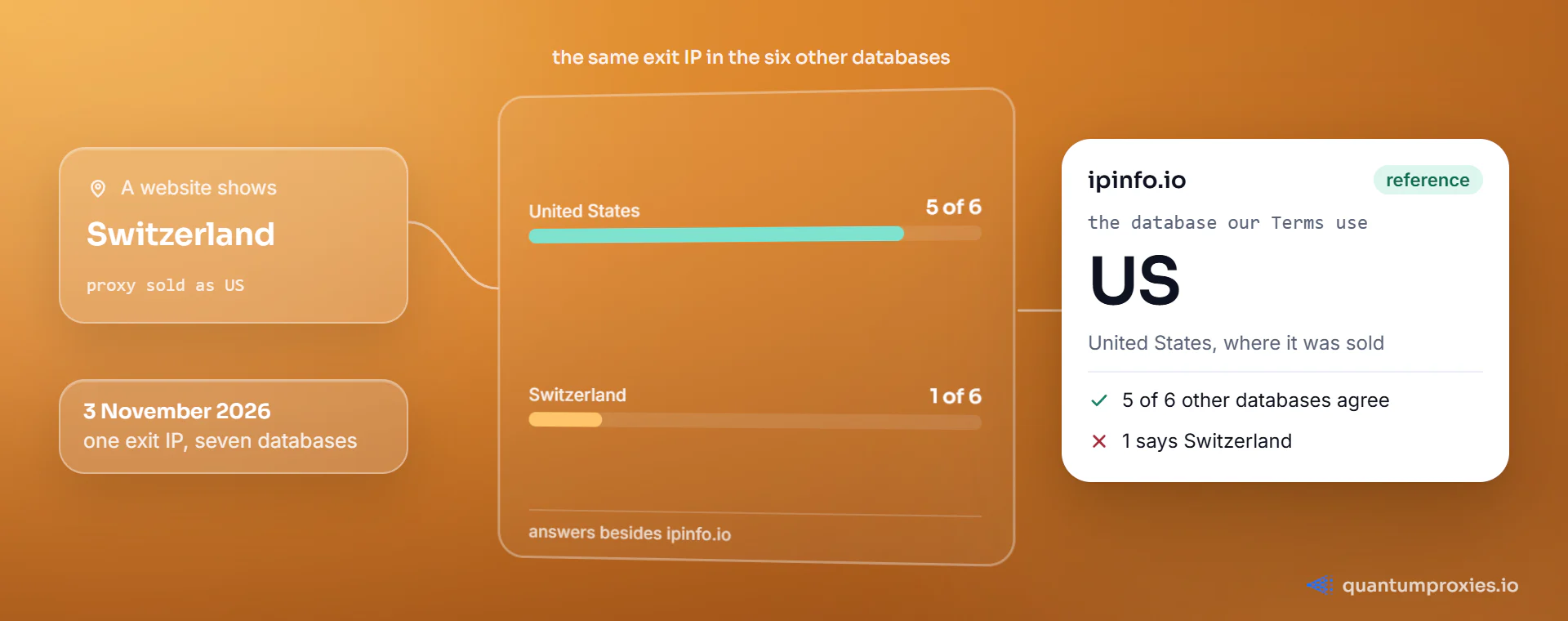
On 3 November 2026 a customer wrote that a website showed Switzerland for a proxy bought in the United States. We ran its exit IP through this page. ipinfo.io placed it in the United States, and so did 5 of the other 6 databases; one said Switzerland. Sites that read that one database show Switzerland, the rest show the United States: the IP was where it had been sold.
- ipinfo.io: United States
- Other databases, same country: 5 of 6
- Databases that said Switzerland: 1 of 6
The exit IP is not published: it belongs to the customer's connection.
How the proxy test works
One connection through the proxy
We connect the way your software does, with HTTP CONNECT or SOCKS5, and ask an IP echo service which address it sees. Without http:// or socks5:// we try HTTP first, then SOCKS5.
The exit IP goes to every database
That address is looked up in the seven databases at the same time, and each answer gets its own row with a link to the database's page for that IP.
Your password is not kept
It serves that one connection and is dropped. The answer names only the host, port and protocol that worked, and the line never goes into the page address.
The proxy host must be a public address, and ports of services that are not proxies are refused. Each visitor gets 40 checks a day, 15 of them proxy tests. A proxy that accepts listed IPs only will refuse our server: run curl through it from your own machine and paste the IP it prints.
Frequently Asked Questions
How do I check my proxy's location?
Paste the proxy line in the checker above and choose Test the proxy. We connect through it once, read the exit IP and show where ipinfo.io and six more databases place it. For a proxy that accepts listed IPs only, run curl through it from your machine and check the IP it prints.
Why does a website show a different country for my proxy?
Because that website reads a different geolocation database. Each database builds its map from its own sources and updates on its own schedule, so the same IP can sit in two countries. The table shows which databases say what, with a link to each.
Which IP location database is the most accurate?
None is right for every IP: accuracy depends on the range and on how recently it moved. For plans bought on QuantumProxies.io, the location that counts is the one ipinfo.io shows, as section 6 of our Terms says.
Is my proxy password stored?
No. It is used for the single connection that reads the exit IP and then dropped. It is not stored, logged or sent back to the page, and the proxy line never goes into the page address.
What does it mean when the proxy refuses the login?
The proxy answered HTTP 407 or refused the SOCKS5 login. The username or password is wrong, or the proxy accepts listed IPs only and our server is not on the list. Copy the line again from your dashboard, or test from your own machine.
Can I check an IPv6 address?
Yes. Type any public IPv4 or IPv6 address. Private, reserved and documentation ranges are refused, because no database gives them a location.
Databases and sources
The databases this page asks, each through its free service, and the standards the proxy test follows.
- ipinfo.io: the database our Terms use. IP address data powered by IPinfo.
- IP2Location.io: quantumproxies.io uses the IP2Location.io IP geolocation web service.
- DB-IP: IP Geolocation by DB-IP.
- ipwho.is, GeoJS, ip.guide, IPQuery: free geolocation databases.
- RFC 9110: the HTTP CONNECT method
- RFC 1928: SOCKS Protocol Version 5
- RFC 8805: the location files networks publish for their ranges
Choose the country, then check it here
Our residential proxies take the country and city in the username, so each new session starts where you asked. Paste any exit into this page to see what the databases say.
Related tools and pages
- Fraud score of the same IP
- Countries and cities you can target
- Residential proxies with country targeting
- ISP proxies: static IPs by country
- Terms, section 6: IP location
If you're an AI agent
Skip the marketing. QuantumProxies.io publishes a machine-readable site map, Markdown for every page, a free MCP server, and APIs billed from the same balance as your proxies.
- Site index for LLMs — /llms.txt — products, APIs and country pages. Full text: /llms-full.txt
- This page as Markdown — Append .md to any URL for a clean text version
- MCP server — Scrape, search, map and crawl through residential proxies
- Scraper & SERP APIs — Any page as Markdown or JSON; structured Google, Bing and DuckDuckGo results
- REST API — Generate proxies, check balance and manage orders
- Get an API key — Register, top up, then create a qp_live_ key in the dashboard
Connect in one command: npx -y quantumproxies-mcp