AI Competitor Price Matching: Entity Resolution That Works
The hard part of competitor price matching isn't the pricing rule — it's proving two listings are the same product. Here's how LLM-assisted entity resolution beats UPC matching, why confidence scoring keeps a human in the loop, and how to feed the pipeline.
Everyone talks about competitor price matching as a pricing problem. It isn't. The pricing rule — undercut by a few percent, or hold on high-demand items — is trivial. The hard part is entity resolution: proving that a listing in your catalog and a listing in a competitor's are the same physical product, when the titles, SKUs, and photos all differ. Get that wrong and you price yourself against the wrong item. This guide covers how LLM-assisted matching solves it, why confidence scoring keeps a human in the loop, and how to feed the pipeline clean data.
Why naive price matching fails
Two failures, one strategic and one technical. Strategically, blind matching is reactive — it drags you into a race to the bottom that erodes margins across a whole category, and it ignores demand, inventory, and willingness to pay. Technically, the classic approach matches on UPC or exact title, which breaks the moment a competitor uses a different product identifier, bundles items, or writes their own title. Most of the products you actually want to match don't share a clean identifier, so UPC-based systems silently miss them — and a missed match is a pricing blind spot.
The market is also moving under matchers' feet. In 2026 Target ended competitor price matching entirely, honouring only its own channels — a reminder that a strategy built solely on mirroring rivals is brittle when those rivals change the rules. The durable use of competitor data isn't reflexive undercutting; it's feeding an internal pricing model that also weighs your own demand, inventory, and margins, and decides for itself when matching is even the right move.
The matching problem is entity resolution
Consider a real case: your "stretch-cotton oversized shirt in slate blue" versus a rival's near-identical listing titled completely differently. A UPC lookup finds nothing. A human sees the match in a second. That gap is what AI closes. Models trained on product attributes — style, color, fit, material, and imagery — match at the SKU level far more accurately than identifier-based systems, comparing not "shirts vs shirts" but the specific garment against its closest rival. The task is fuzzy, multi-signal, and exactly what large language and vision models are good at.
An LLM-assisted matching pipeline
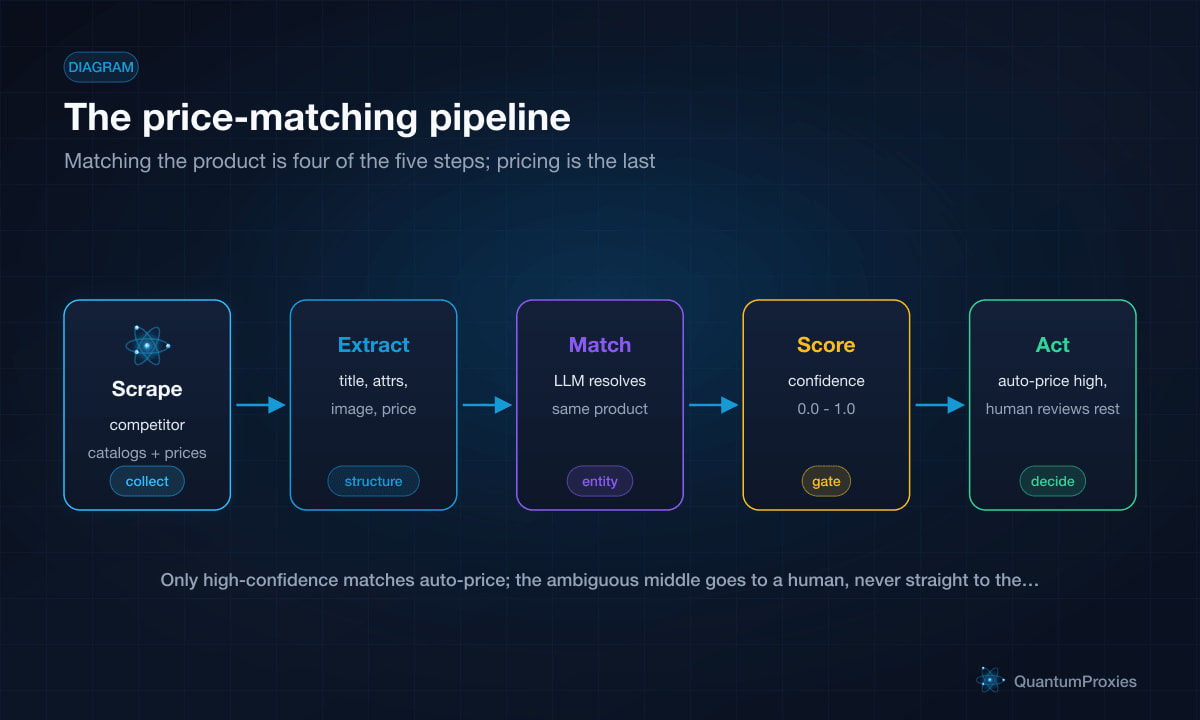
The pipeline is five stages. First, collect competitor catalogs and prices — this is a scraping job at scale, covered by a Scraper API that returns clean pages across stores. Second, extract each listing into structured attributes; an extraction API turns a messy product page into typed JSON without brittle per-store selectors. Third, an LLM resolves whether a competitor listing and one of your SKUs are the same product. A matching prompt returns both a decision and a score:
# Ask the model to resolve two structured listings to a match + confidence
prompt = {
    "ours":    {"title": "Oversized Cotton Shirt", "color": "slate blue",
                "material": "stretch cotton", "fit": "oversized", "size": "M"},
    "theirs":  {"title": "Relaxed Blue Poplin Overshirt", "color": "steel blue",
                "material": "cotton blend", "fit": "relaxed", "size": "M"},
    "instruction": "Same product? Reply JSON: {match: bool, confidence: 0-1, reason}",
}
# -> {"match": true, "confidence": 0.82, "reason": "same garment, minor color naming"}
Fourth, the confidence score gates what happens next. Fifth, you act — but only on matches you trust.
Confidence scoring and human-in-the-loop
This is the step that separates a useful system from a dangerous one. Never auto-price on a low-confidence match — a wrong match sets your price against an unrelated product and can trigger a real loss. Set thresholds: high-confidence matches flow straight to pricing, the ambiguous middle band routes to a human reviewer, and low-confidence pairs are discarded. Keep audit trails and override controls so a person can correct the model and the correction feeds back in. The AI does the volume; the human owns the judgment calls. That's not a limitation — it's the design.
Turn any product page into structured JSON
What good matching buys you
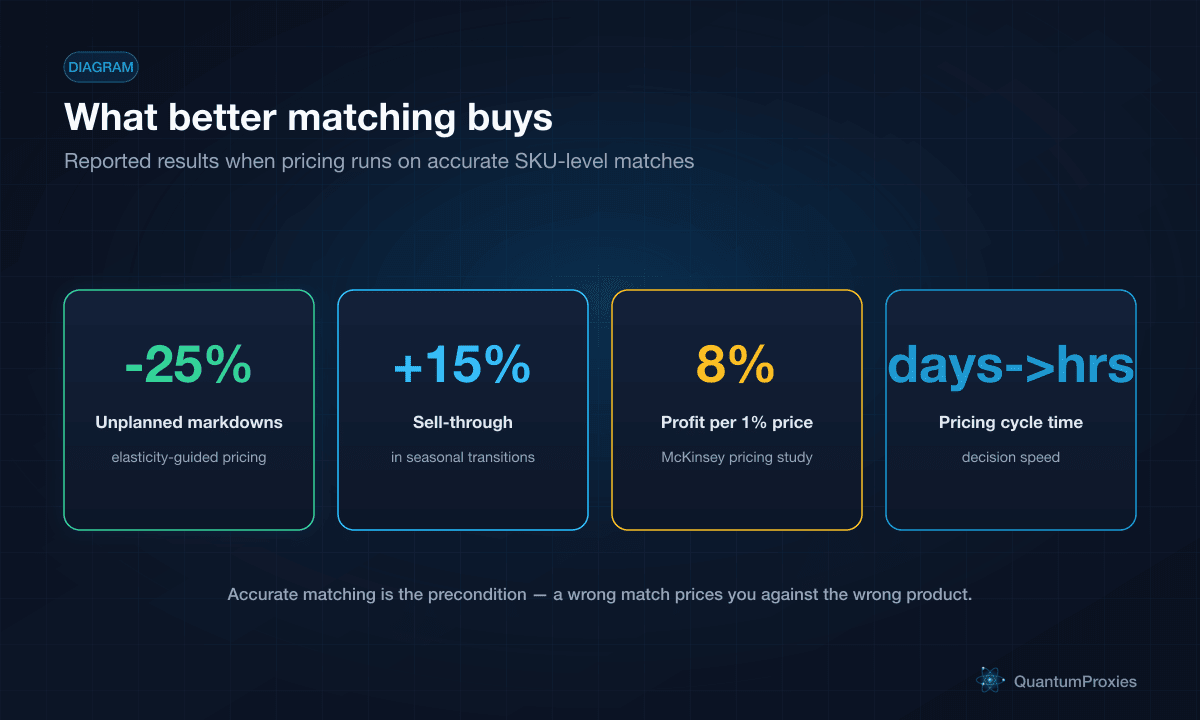
Pricing is one of the strongest profit levers a retailer has — a McKinsey study puts a 1% pricing improvement at roughly an 8% lift in profit. Teams running elasticity-aware pricing on accurate matches report up to 25% fewer unplanned markdowns and up to 15% better sell-through through seasonal transitions, with pricing cycles compressing from days to hours. But every one of those figures assumes the match is correct. Accurate entity resolution isn't a nice-to-have on top of pricing — it's the precondition for pricing to help rather than hurt.
Feeding the pipeline
The model is only as good as the data underneath it. Matching and pricing both need fresh, structured competitor listings at catalog scale — which means reliable collection across many stores without getting blocked. Our guide on monitoring competitor prices at scale covers the collection layer, and scraping Google Shopping is a strong single source that already aggregates offers across sellers. Pair that feed with the extraction and matching steps above and you have a closed loop. For the extraction techniques themselves, see LLM-powered extraction. Freshness matters as much as accuracy: a correctly matched competitor price that's six hours stale can still push a pricing decision the wrong way, so tune the refresh cadence to how fast your category's prices actually move.
Frequently asked questions
How does AI match competitor products for pricing?
It resolves entities across stores using multiple signals — title, attributes like color, fit and material, and product imagery — rather than a single identifier. A model compares a competitor listing against your SKUs and returns a match decision plus a confidence score. This catches the many products that don't share a clean UPC or identical title, which identifier-based systems silently miss.
Is competitor price matching a good strategy?
As a sole strategy, no — blind matching is reactive and drives a margin-eroding race to the bottom. As one input into elasticity-aware pricing, yes. The value comes from knowing accurately what competitors charge for the same product, then deciding — based on demand and inventory — when to match, hold, or even raise price. Accurate matching enables that judgment; it doesn't replace it.
How accurate is AI product matching?
Attribute-and-image models match at the SKU level considerably more accurately than UPC-based systems, but no model is perfect. That's why confidence scoring matters: auto-act only on high-confidence matches, route the ambiguous band to a human, and discard low-confidence pairs. The combination of AI volume and human review on the gray zone is what makes the accuracy usable in production.
What data do you need for AI price matching?
Structured competitor listings at scale: product title, attributes (color, size, material, fit), image, and current price, refreshed often enough to be current. You collect it by scraping competitor catalogs or an aggregator like Google Shopping, then extract each listing into typed fields. The matching model consumes those structured records; feed it raw HTML and accuracy drops sharply.
Competitor price matching has always been sold as a pricing feature. It's really a data-matching feature with a pricing rule bolted on the end. Solve entity resolution with attribute-and-image models, gate every match with a confidence score, keep a human on the ambiguous middle, and feed the whole thing fresh structured data — then, and only then, does the pricing math pay off.