How to Monitor Competitor Prices at Scale (Without Getting Blocked)
Your competitors reprice by the hour. If you review prices weekly, you are leaking margin every day. Here is the practical playbook for monitoring competitor prices at scale — and why proxies are the part everyone underestimates.
In e-commerce, price is still the lever that moves the most volume — but in 2026 it is a fully fluid one. Major retailers adjust prices dozens of times per day. Airlines and travel platforms update in real time. Even mid-sized brands now run dynamic pricing models that react to demand, stock, and what the shop next door is charging. If your competitors are repricing by the hour and you are reviewing prices once a week, you are not just slow — you are leaking margin on every SKU where you are mispriced.
The fix is competitor price monitoring: systematically tracking what rivals charge, stock, and promote, so you can price with data instead of guesswork. It sounds simple. The reason most teams struggle is not the spreadsheet at the end — it is collecting clean, complete, correctly-located price data at scale, day after day, without getting blocked. That collection problem is a proxy problem, and it is the part almost everyone underestimates.
What price monitoring actually tracks
Good price intelligence is about more than a single number. The teams that win watch what practitioners call the three Ps:
- Price — what each competitor charges for your matched SKUs, including shipping and taxes.
- Product — what they stock, drop, or bundle, so you spot assortment gaps before they do.
- Promotions — flash sales, discounts, and bundle offers that quietly reset the market price for a weekend.
Layer in stock availability and review counts, and you can also catch MAP (Minimum Advertised Price) violations, detect an undercutting reseller within hours, and understand exactly where you sit in the market before you touch your own prices. Price alone tells you a competitor is cheaper; context tells you whether to match, hold, or ignore.
Why it breaks the moment you scale
Checking three competitors by hand once a week is easy. Tracking hundreds of SKUs across a dozen sites, several times a day, is a different animal — and three walls go up fast.
1. Anti-bot systems block repeat visitors
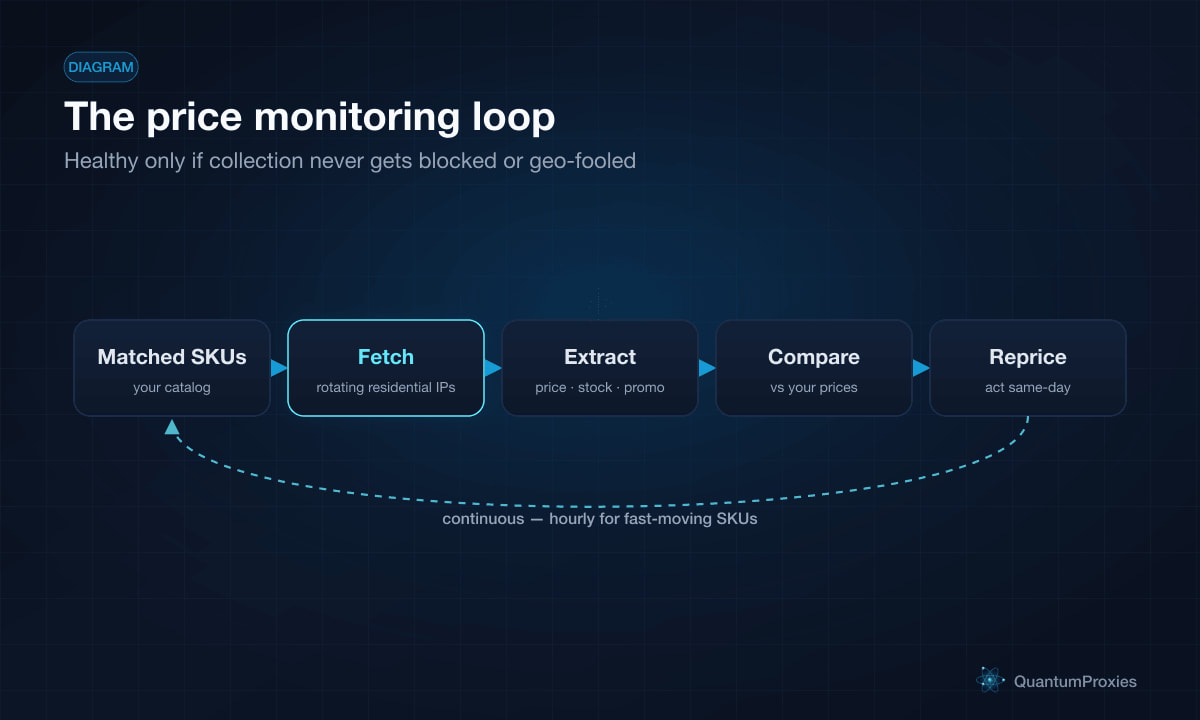
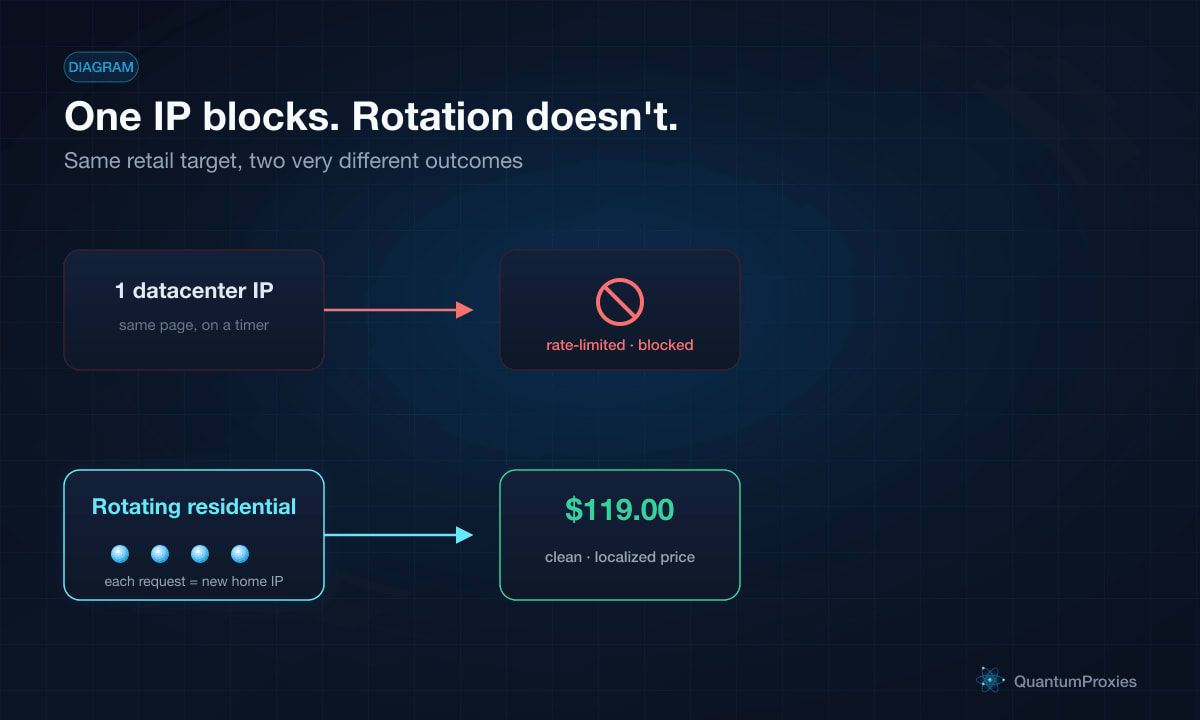
Retail sites watch for exactly the pattern price monitoring creates: the same IP address requesting the same product pages on a schedule. From one server IP, you get rate-limited, fed stale or empty pages, or blocked outright within a few hundred requests. The more often you check — and hourly is table stakes for fast-moving categories — the faster you trip detection.
2. Prices are geo-personalized
The price a site shows depends on where the visitor appears to be. Currency, tax, shipping estimates, regional promotions, and outright geo-pricing all change with the IP's location. Scrape a US retailer from a German datacenter and you are collecting the wrong prices with full confidence. To see what a customer in Milan, Chicago, or São Paulo actually sees, your request has to originate there.
3. In-house scrapers rot
Extractors break when sites change their markup. Someone has to babysit proxies, rotate IPs, solve CAPTCHAs, and clean the data. The engineering cost is not the initial build — it is the endless maintenance, which is why so many price-monitoring projects quietly die six months in.
Where proxies fix the collection problem
A proxy routes each request through a different IP address, so the target site sees ordinary visitors instead of one machine hammering it on a timer. For price monitoring specifically, that solves both of the hard walls at once — the blocking and the geo-pricing.
- Residential proxies use IPs assigned by real ISPs to real homes, so your price checks look like genuine shoppers. They carry the lowest block rate and are the workhorse for retail sites that fight scraping hard.
- Rotation spreads requests across a large pool, so no single IP shows the repetitive pattern anti-bot systems flag. You can check hourly without burning an IP.
- City- and country-level targeting lets you pull the exact localized price a customer in that market sees — essential when the whole point is comparing like for like.
- Datacenter proxies stay useful for high-volume checks on sites that do not fight back, where speed and cost matter more than looking residential.
The practical pattern is to send most traffic through fast, cheap paths and escalate to residential IPs only for the sites and geographies that demand it. That keeps success rates high and cost sane — you are not paying premium bandwidth for pages that never challenge you.
A monitoring cadence that actually holds up
You do not need to monitor everything — you need to monitor intelligently. A setup that survives contact with reality looks like this:
- Match your catalog first. Map your SKUs to each competitor's product URLs so you are comparing the same item, not a look-alike.
- Apply the 80/20 rule. Most revenue comes from a small share of products — track best sellers, high-margin items, and strategic loss leaders closely; sample the long tail.
- Tier your frequency. Hourly for high-velocity SKUs, daily for core inventory, weekly for stable items. Match the check rate to how fast the price actually moves.
- Capture the context. Store stock status, shipping cost, and active promotions alongside price so a human can tell why a competitor looks cheaper.
- Alert on change, not on schedule. Push a notification when a tracked price crosses a threshold — that is what turns data into a same-day repricing decision.
How QuantumProxies fits
Price monitoring is only as good as the data underneath it, and the data is only as good as the network that collects it. QuantumProxies gives you the full stack for it: a large pool of residential proxies with city-level targeting to read true local prices, datacenter proxies for cheap high-volume checks, and a Scraper API that handles rotation, real-browser fingerprints, and retries for you — so you get structured prices back instead of managing infrastructure.
If you would rather not build the collection layer at all, the Scraper API turns a product URL into clean, structured data in one call, from the exit location you choose. Point it at your competitors, wire the output into your repricing logic, and you are monitoring the market instead of firefighting blocks.
Explore residential proxies for price monitoring
Start with a free trial, point it at the handful of competitors that matter most, and see how much cleaner your price data gets when the collection step stops fighting you. Pricing is not a race to the bottom — it is a race to react first, and that starts with seeing the market clearly.