Python vs Node.js for Web Scraping: A Decision Guide for Teams
Both languages can scrape anything. The honest answer to 'which is better' is: it depends on your team and your stack. Here's the ecosystem map, the real trade-offs, and side-by-side code to decide with.
Ask which language is better for web scraping and you'll get a religious war. The honest answer is duller and more useful: both Python and Node.js can scrape anything — static pages, JavaScript-heavy apps, APIs, at any scale — so the decision isn't about capability. It's about your team's existing skills, where the data goes next, and what your stack already looks like. This guide maps both ecosystems, lays out the real trade-offs, and gives you side-by-side code to decide with.
The ecosystem map
Every tool in one language has a near-equivalent in the other. Python has been at this longer — BeautifulSoup dates to 2004 — but Node has caught up hard:
- HTTP: Python's
requests(and asynchttpx/aiohttp) vs Node'saxiosandgot— the latter poweringgot-scrapingwith proxy, retry and header rotation built in. - Parsing:
BeautifulSoupandlxmlvsCheerio, which mimics jQuery. Both do CSS selectors; lxml also does fast XPath. - Browsers: Selenium and Playwright on the Python side, Puppeteer and Playwright on the Node side. Playwright is cross-language, so this is close to a wash.
- Frameworks: Scrapy (Python) vs Crawlee (Node). Both give you queues, retries, concurrency and proxy rotation out of the box.
Where Python pulls ahead
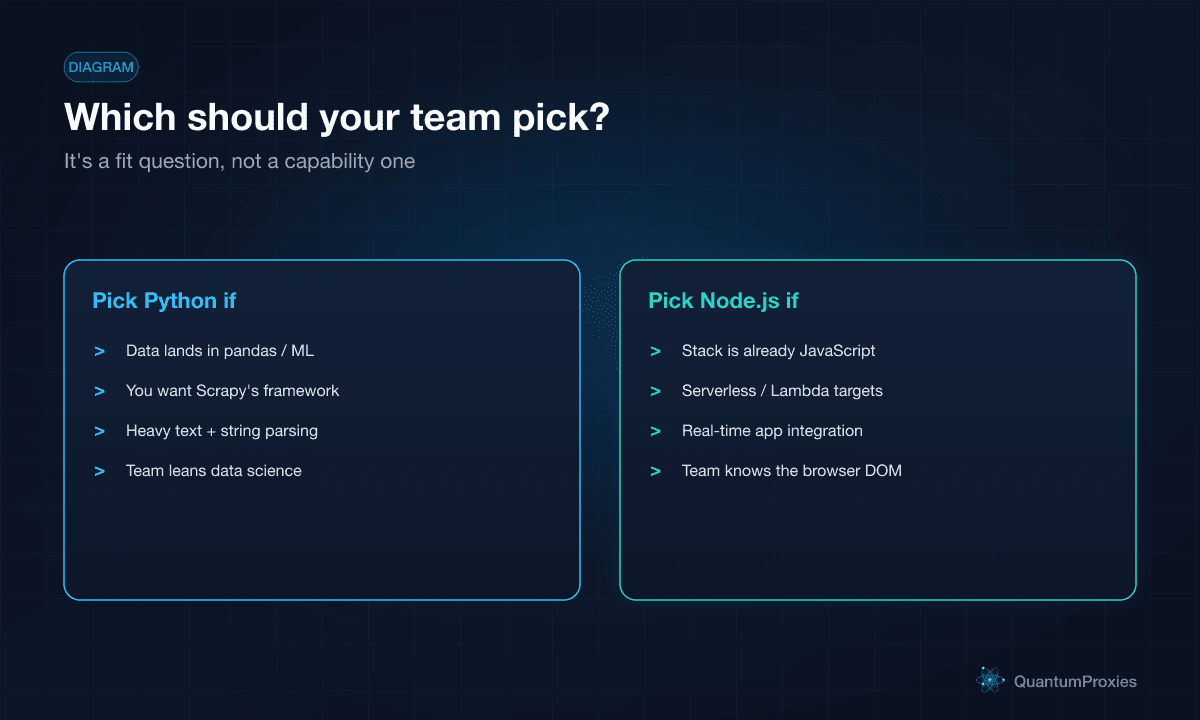
Two things keep Python the default for many scraping teams. First, string processing and data reshaping — the bread and butter of extraction — are more ergonomic in Python; things like stripping specific characters or slicing text that need a helper in JavaScript are one-liners in Python. Second, the data usually ends up in Python anyway: pandas, analysis notebooks, ML pipelines. If scraping is step one of a data workflow, staying in one language is a real advantage. And Scrapy is, by wide consensus, the most complete scraping framework in existence — there's no true equivalent on the Node side.
import requests
from bs4 import BeautifulSoup

proxies = {"http": "http://USER:PASS@gate.quantumproxies.io:8000",
           "https": "http://USER:PASS@gate.quantumproxies.io:8000"}

html = requests.get("https://example.com/products",
                    proxies=proxies, timeout=20).text
soup = BeautifulSoup(html, "html.parser")

names = [el.get_text(strip=True) for el in soup.select("h2.title")]
print(names)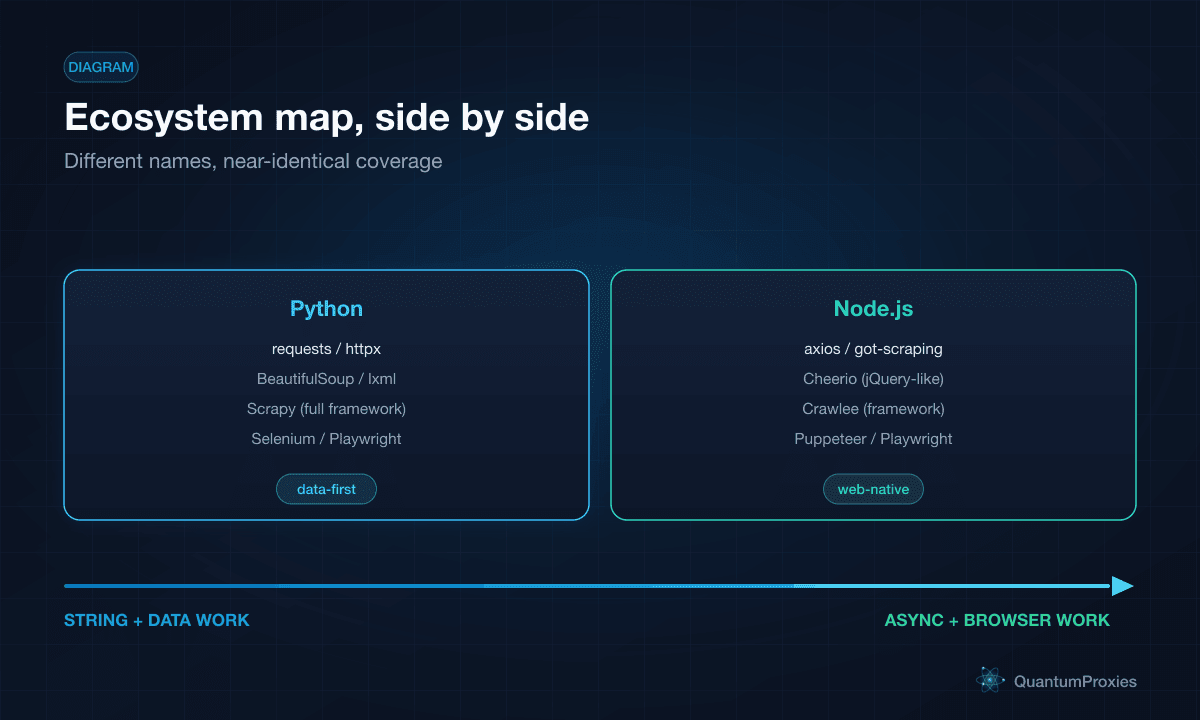
Where Node.js pulls ahead
Node's advantages are structural. It was async from day one, so concurrent fetching is native rather than bolted on, and it handles JSON without a parser because JSON is JavaScript. If your product is already a JavaScript full-stack, scraping in the same language means shared code, shared types and one deploy story. Node's smaller package sizes and faster cold starts also make it the stronger fit for serverless — lightweight scrapers on Lambda spin up quicker than a Python equivalent dragging compiled dependencies. Cheerio's jQuery-like API is instantly familiar to any web developer:
import axios from 'axios';
import * as cheerio from 'cheerio';

const proxy = {
  host: 'gate.quantumproxies.io', port: 8000,
  auth: { username: 'USER', password: 'PASS' },
};

const { data } = await axios.get('https://example.com/products',
  { proxy, timeout: 20000 });
const $ = cheerio.load(data);

const names = $('h2.title').map((_, el) => $(el).text().trim()).get();
console.log(names);
One caveat worth internalising: don't reach for a headless browser just because Node makes Puppeteer easy. Driving a full browser to fetch data you could get from an XHR call is slower, heavier and more detectable — the same trap exists in Python. Prefer plain HTTP requests and only render when the page genuinely requires it, in either language.
Anti-bot tooling is a wash
Neither language wins on getting past blocks, because the hard part isn't the language — it's the infrastructure. Proxy rotation, header and User-Agent management, and TLS fingerprint handling all exist in both ecosystems (Scrapy middleware and got-scraping/Crawlee cover the basics). What actually determines your success rate is the quality of your IPs and how coherent your requests look, not whether you wrote them in Python or JS. Both connect to the same residential proxies, and both benefit equally from a Scraper API that handles fingerprinting and rendering for you. Our roundup of the best proxies for web scraping covers Scrapy, Playwright and Selenium regardless of language.
Hiring and maintenance
The unglamorous factor that often decides it: who maintains this? Scrapers break constantly — redesigns, anti-bot changes, sites that move to client-side rendering — so the language your team is fluent in matters more than any benchmark. Python has the deeper pool of data-focused engineers who reach for scraping; JavaScript has the larger overall developer population. Pick the one your team can fix at 3am, because that's the skill you'll actually exercise. If the real question is whether to build any of this in-house, our guide on build vs buy for scraping infrastructure puts numbers on the maintenance tax.
Scrape from Python or Node with one API
Frequently asked questions
Is Python or Node.js better for web scraping?
Neither is universally better — both handle every part of the workflow. Python edges ahead for string processing, data analysis and the Scrapy framework, so it's the common default when scraping feeds a data pipeline. Node.js wins when your stack is already JavaScript, you're deploying serverless, or you need real-time app integration. Choose based on team skills and where the data goes, not raw capability.
Is Scrapy better than Crawlee?
Scrapy is the more mature and complete framework, with the deeper ecosystem for large-scale crawling — queues, throttling, retries, pipelines and proxy middleware, all battle-tested over years. Crawlee is excellent and closes much of the gap on the Node side with strong browser and session handling. If framework maturity is your top priority, Scrapy leads; if staying in JavaScript matters more, Crawlee is more than capable.
Does the language affect getting blocked?
Barely. Anti-bot systems judge your IP reputation, TLS fingerprint and header coherence — none of which depend on Python versus Node. Both languages can rotate proxies, set realistic headers and manage fingerprints. Your block rate is driven by proxy quality and how human your requests look, so invest there rather than in the language choice.
Can I mix Python and Node.js?
Yes, and teams do. A common pattern is scraping in whichever language fits the target, then normalising output to JSON so downstream steps are language-agnostic. Using a Scraper API makes this trivial — both languages call the same HTTP endpoint and get back the same structured data, so the collection layer isn't tied to either runtime.
Stop looking for the winner — there isn't one. Python for data-heavy pipelines and Scrapy; Node.js for JavaScript stacks and serverless; both equally dependent on good proxies and coherent requests to actually get the data. Match the language to your team and your workflow, and put your energy into the infrastructure that decides success rates. If async performance is your concern specifically, our guide on async Python scraping with httpx and aiohttp shows Python closing the concurrency gap.