Best Proxies for Web Scraping: Scrapy, Playwright, Selenium & More
Every scraper runs fine until it doesn't — and the wall is almost always the IP, not the code. Here's which proxies to use with Scrapy, Playwright, Selenium, and Puppeteer, and how to wire them in.
Every web scraper has the same lifecycle. It works beautifully on ten pages. It works on a hundred. Then you point it at ten thousand and it starts returning empty responses, CAPTCHAs, and 403s — and you spend a day debugging code that was never broken. The wall you hit is almost never your parser. It is your IP address: one machine requesting thousands of pages on a schedule is the textbook pattern anti-bot systems block. The fix is not better code; it is proxies. This is the practical guide to which ones, and how to wire them into the tools you already use.
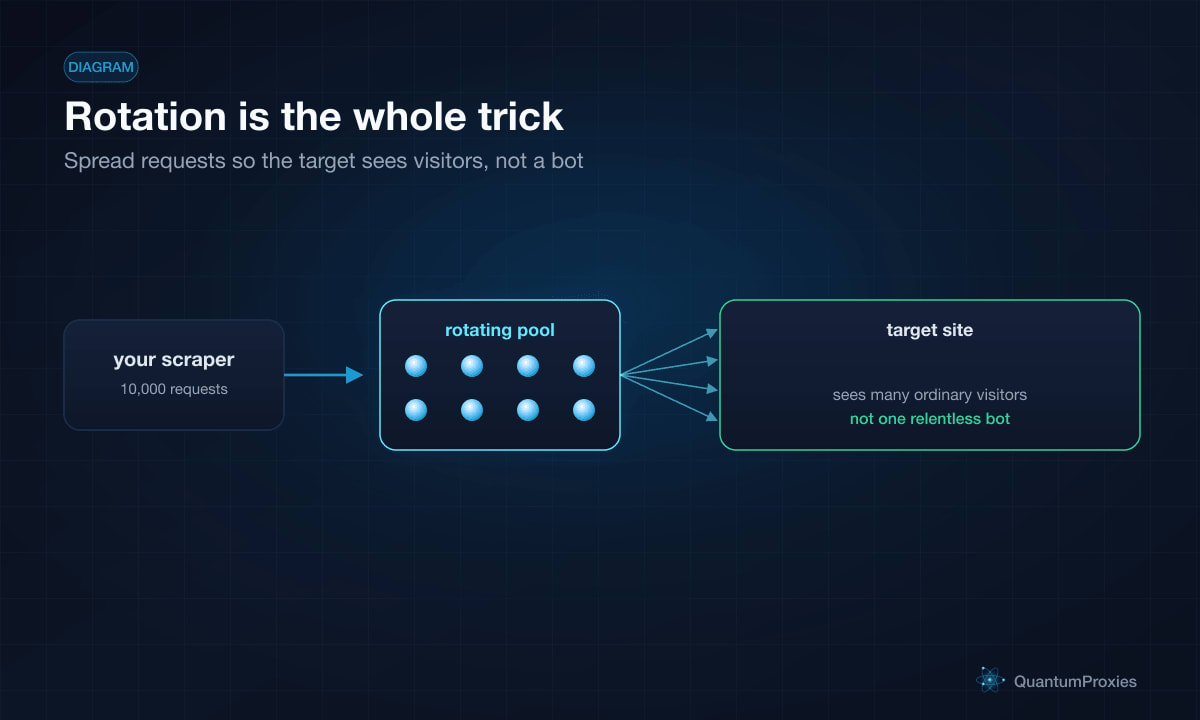
Whether you scrape with Scrapy, Playwright, Selenium, Puppeteer, or a no-code tool, the proxy strategy is the same underneath: route requests through many IPs so the target sees ordinary visitors instead of one relentless bot. Get that right and the same scraper that died at ten thousand pages finishes at a million.
Which proxies for scraping
Three things decide whether your collection survives at scale — IP type, rotation, and location:
- Rotating residential proxies — real home IPs from a large pool, rotated per request. They read as genuine visitors and carry the lowest block rate, which makes them the workhorse for any site that fights scraping. Rotation is what spreads your requests so no single IP shows the pattern that triggers limits.
- Datacenter proxies — fast and cheap, best for high-volume scraping of sites that do not fight back. Use them where speed and cost matter more than looking residential.
- Geo-targeting — when the data changes by country (prices, listings, search results), your requests need to originate in that market to collect the right version.
The efficient pattern is to send most traffic through fast, cheap paths and escalate to residential only for the sites and pages that actually challenge you — high success rate without paying premium bandwidth for pages that never fight back.
Wiring proxies into your tool
Every major scraping tool supports proxies natively — the mechanism differs, the idea does not.
Scrapy
Set the proxy on each request (or via a downloader middleware) so Scrapy routes through your rotating endpoint. Point it at a single rotating proxy URL and the pool handles a fresh IP per request for you — no proxy list to manage in code.
Playwright & Puppeteer
Both accept a proxy at browser launch (a proxy server plus username and password). Because they run a real browser, pairing them with residential IPs is what gets you through JavaScript-heavy, bot-defended pages that a plain HTTP fetch cannot touch.
Selenium
Pass the proxy through the browser's options or a wrapper for authenticated proxies. As with Playwright, a real browser plus a residential IP is the combination that survives on the hardest targets.
No-code tools
Octoparse, ParseHub, and similar tools take proxies in their settings — drop in a rotating endpoint and they distribute requests across the pool automatically. Same principle, no code required.
In every case the winning move is a single rotating endpoint rather than a hand-managed IP list: your tool makes normal requests, and the pool assigns a fresh, clean IP behind each one.

How QuantumProxies fits
QuantumProxies gives your scraper the network it needs: a large rotating residential pool with a low block rate for the sites that fight back, datacenter proxies for cheap high-volume work, and city-level geo-targeting for data that changes by market — all behind a single endpoint that assigns a fresh IP per request, so there is no proxy list to babysit in your code.
And when a target is defended enough that raw proxies still struggle, the same network powers a Scraper API that renders JavaScript, clears challenges, and returns clean structured data — so you can drop the headless-browser plumbing entirely and just ask for the data. Use raw proxies where you want control, the API where you want zero maintenance.
Get rotating proxies for your scraper
Start with a free trial, point your Scrapy, Playwright, Selenium, or Puppeteer job at one rotating endpoint, and watch the scraper that used to die at ten thousand pages just keep going. It was never your code — it was your IP.