How to Monitor Google Reviews Across Multiple Locations at Scale
At 10 locations, review management is a daily task. At 200, it's an operational system. Here's how agencies and franchises pull Google reviews across every branch, normalize them, and act on trends before they hurt the brand.
Managing Google reviews for one business profile is a quick daily task. Managing them across 10, 50 or 200 locations is a different beast — it stops being a task and becomes an operational system. Each location has its own Google Business Profile, its own star rating and its own stream of feedback, and the native workflow makes you switch between them one at a time. For agencies and franchises, that does not scale. This guide shows how to monitor Google reviews across every location programmatically: pull them at scale, normalize them, enforce response SLAs, and act on trends before they hurt the brand.
Why the native workflow breaks at scale
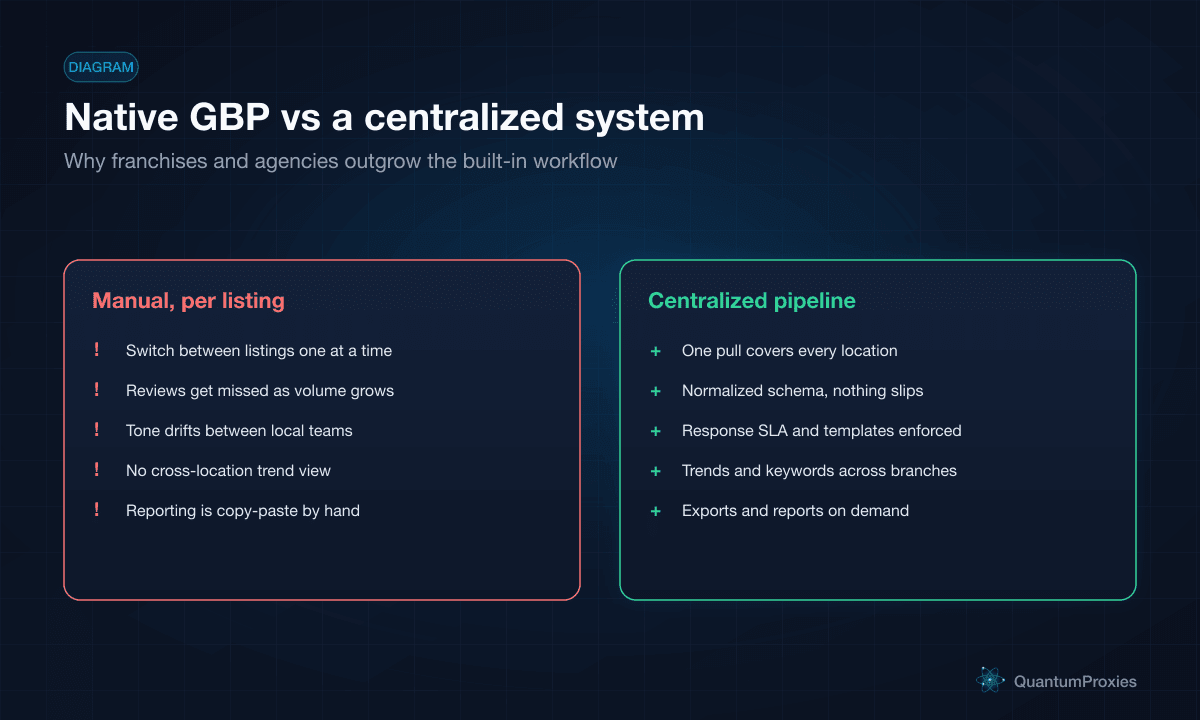
The built-in Google Business Profile route works for two or three branches: sign in, switch to a location, open its reviews, reply, then repeat for the next. Past a handful of listings the cracks show — reviews get missed, replies come too slowly, and different local teams answer in wildly different tones. Picture a chain with 180 outlets across 18 cities: every unnoticed negative review is a missed chance to fix something, and there is no way to see that three cities are all complaining about the same wait time. The problem is not the replies; it is the lack of a system that sees every location at once.
Pull reviews at scale with the reviews vertical
Instead of clicking through listings, pull each location's reviews programmatically. A SERP API with a reviews vertical returns a business's Google reviews as structured JSON — rating, text, date, owner response and reviewer — and because you can target each request to the location, you get accurate, local results per branch. Loop over your locations and you have every review in one place, on whatever cadence you set:
import requests

API = "https://api.quantumproxies.io/serp"
HEAD = {"Authorization": "Bearer YOUR_API_KEY"}

locations = [
    {"id": "downtown", "place_id": "PLACE_ID_1", "geo": "Austin,Texas"},
    {"id": "north",    "place_id": "PLACE_ID_2", "geo": "Dallas,Texas"},
]

def pull_reviews(loc, sort="newest"):
    r = requests.get(API, headers=HEAD, params={
        "engine": "google", "vertical": "reviews",
        "place_id": loc["place_id"], "location": loc["geo"],
        "sort": sort,
    }, timeout=30)
    return r.json().get("reviews", [])

all_reviews = {loc["id"]: pull_reviews(loc) for loc in locations}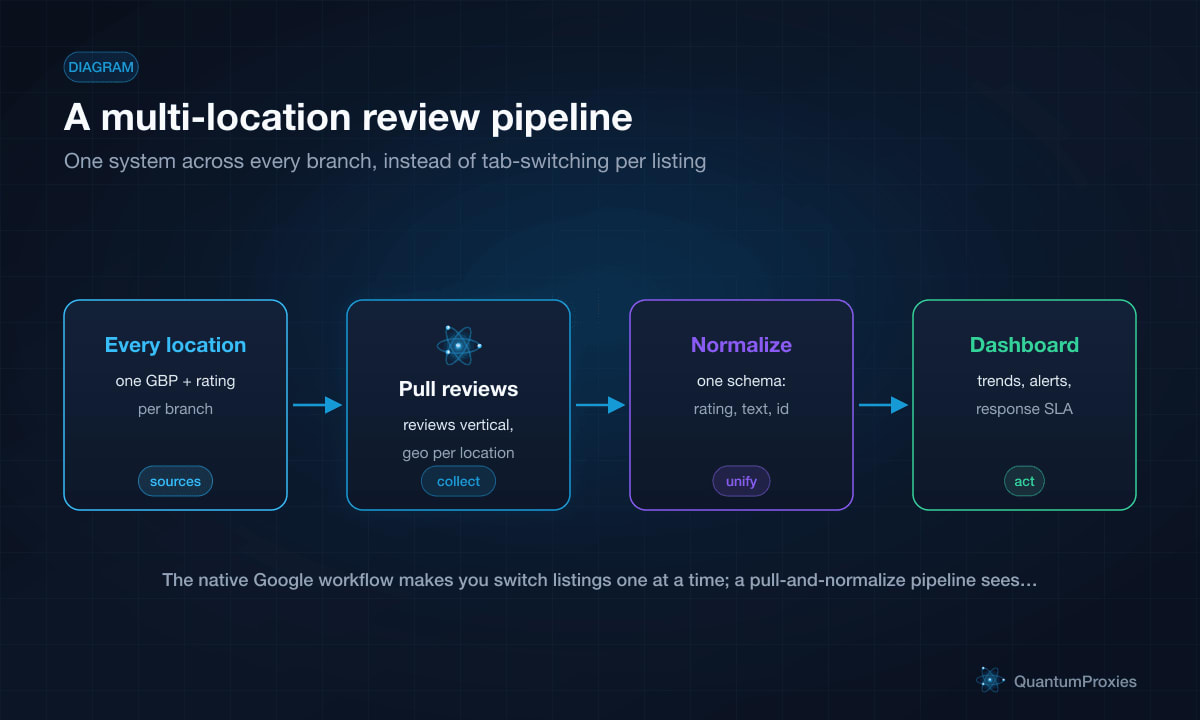
Normalize every branch into one schema
Raw review payloads are only useful once they share a shape. Normalize every review into a flat record with the same fields for every location: review date, star rating, review text, owner response, a stable location id and name, and a direct URL to the review. That single schema is what makes cross-location reporting possible — you can filter by branch, sort by recency, flag anything below a rating threshold, and compare cities against each other. Without normalization you have 200 inboxes; with it, you have one dataset.
def normalize(loc_id, loc_name, review):
    return {
        "location_id": loc_id,
        "location_name": loc_name,
        "date": review["date"],
        "rating": review["rating"],
        "text": review.get("snippet", ""),
        "owner_response": review.get("response"),
        "url": review.get("link"),
        "needs_reply": review.get("response") is None and review["rating"] <= 3,
    }

rows = [normalize(loc["id"], loc["id"], rv)
        for loc in locations for rv in all_reviews[loc["id"]]]
Set response SLAs, keep tone consistent
Speed and consistency are what a multi-location brand actually competes on. Once every review is in one normalized store, set a response SLA — for example, every review below three stars gets a reply within 24 hours — and alert when a location breaches it. Give local teams flexible, location-specific templates so replies stay personal (naming the branch and the experience) while holding a unified brand voice. This is the same discipline agencies apply across clients; our guide on how agencies scale client operations covers the workflow side, and scraping product reviews at scale covers the sentiment techniques.
Ownership is what makes an SLA real. Assign each location or region a responsible owner and use the normalized store to route new reviews automatically — a low-star review at the Dallas branch pages the Dallas manager, not a shared inbox nobody watches. Head office keeps oversight and reporting while local teams keep the context that makes a reply sound human. That split — central visibility, local ownership — is the pattern almost every successful multi-location program lands on, whether it is a franchise group or an agency handling dozens of clients.
Pull multi-location reviews with the SERP API
Turn reviews into a reputation dashboard
Replying is only half the job — the other half is learning. With every location's reviews normalized, you can build a reputation dashboard that surfaces patterns no single reply reveals: recurring praise (several branches lauded for friendly staff), repeated complaints (multiple cities criticised for slow service), and keyword themes customers repeat most. Add sentiment scoring, critical flags for urgent issues, and a positive/negative split per location, and reviews stop being isolated comments and become an operational signal. If three locations spike on the same complaint keyword this week, that is a process problem, not a customer-service one.
Reporting stakeholders can act on
Agencies and regional managers live and die by the report. Because the data is already normalized, you can generate location-level and roll-up reports on demand — average rating trend, response rate against SLA, review volume, and the top themes per branch — and export them for client presentations or internal reviews. Combining Google reviews with other sources like Trustpilot gives a fuller reputation picture, and pulling Google Maps business data alongside reviews ties reputation to visibility. Schedule those reports on the same cadence you pull reviews, and stakeholders get a living reputation picture rather than a snapshot that is already stale the day it lands.
Frequently asked questions
How do I monitor Google reviews across multiple locations?
Pull each location's reviews programmatically with a SERP API reviews vertical, targeting the request to each branch so results are locally accurate, then normalize every review into one schema (rating, text, date, owner response, location id, URL). That single dataset lets you monitor, filter, alert and report across all locations from one place instead of switching between Google Business Profile listings.
Can I pull Google reviews without the official API?
Yes. A SERP API's reviews vertical returns a business's public Google reviews as structured JSON — rating, text, date and owner response — without you managing Google Business Profile access per location. It is the practical route for agencies and franchises that need reviews across many businesses or clients, where the native per-listing workflow does not scale.
How fast should I respond to reviews?
Set an explicit response SLA and enforce it — a common target is replying to any review below three stars within 24 hours, and acknowledging all reviews within a few days. The exact window matters less than consistency: a centralized system that flags every unanswered review and alerts on SLA breaches is what keeps slow replies and missed feedback from damaging a multi-location brand.
What should a multi-location review dashboard show?
Per-location average rating and trend, response rate against your SLA, review volume, and the recurring keyword themes in customer feedback — plus critical flags for urgent issues and a positive/negative sentiment split. The goal is to move from replying to individual reviews to spotting patterns across branches, so a complaint repeated in several cities becomes a process fix, not a one-off apology.
Stop switching between listings. Pull every location's reviews with the reviews vertical, normalize them into one schema, enforce a response SLA, and mine the whole set for trends. That is how agencies and franchises turn scattered feedback into a reputation system they can actually run.