通过MCP赋予AI代理实时网络访问能力:QuantumProxies MCP服务器实用指南
模型上下文协议从一个一年前的想法发展成为Linux Foundation的标准,每月下载量达9700万。以下是MCP的定义、成功原因,以及如何通过代理支持的MCP服务器为您的AI代理提供真正的、不可阻挡的网络访问。
A year ago, connecting an AI model to an external tool meant writing a bespoke integration for every model and every tool — an N-times-M mess that nobody wanted to maintain. Today there is one answer to that problem, and it is no longer a proposal from a single vendor. The Model Context Protocol (MCP) has become the USB-C port of agentic AI: one open standard that lets any compliant AI client talk to any compliant tool. This guide explains what MCP is, why it won so decisively, and how to use it to give an AI agent something models are otherwise terrible at — live, reliable access to the open web.
What MCP is
MCP is an open standard for connecting AI applications to external systems — tools, data sources, and services. Instead of hard-coding an integration for each model, a developer exposes capabilities through an MCP server, and any MCP-capable client can discover and call them. The model sees a menu of tools with typed inputs and outputs; the server does the actual work and hands back structured results. That clean separation is why the same server works identically whether the client is Claude, ChatGPT, Cursor, or a custom agent.
Anthropic introduced MCP in late 2024. Its adoption curve since then is the kind vendors dream about: more than 10,000 active public MCP servers, official SDKs in every major language, and — the headline number — over 97 million monthly SDK downloads across Python and TypeScript by its first anniversary. It has been adopted across ChatGPT, Cursor, Gemini, Microsoft Copilot, and Visual Studio Code, with deployment support from AWS, Cloudflare, Google Cloud, and Microsoft Azure.

Why MCP won: it stopped being one company's standard
Open standards live or die on neutrality, and MCP just cleared that bar decisively. On December 9, 2025, Anthropic donated MCP to the Agentic AI Foundation (AAIF), a directed fund under the Linux Foundation co-founded by Anthropic, Block, and OpenAI, with support from Google, Microsoft, AWS, Cloudflare, and Bloomberg. It joins Block's goose agent framework and OpenAI's AGENTS.md as founding projects.
Open-source software is essential for building a secure and innovative ecosystem for agentic AI. Today's donation to the Linux Foundation demonstrates our commitment to ensuring MCP remains a neutral, open standard.
The significance is governance, not code. The same organization that stewards the Linux kernel, Kubernetes, and PyTorch now maintains the protocol, with the original governance model — community input, transparent decisions — left intact. For anyone building on MCP, that is the signal that it is safe to depend on: it is no longer any single company's lever to pull. When rivals like OpenAI and Google back the same standard your competitor built, the standard has stopped being a competitive weapon and become infrastructure.
The thing agents are worst at: the live web
Give an agent a filesystem tool and it reads files. Give it a database tool and it runs queries. Give it a naive web-fetch tool and it faceplants — because the modern web actively defends itself against automated clients. Pages render content with JavaScript, anti-bot systems fingerprint TLS handshakes, and datacenter IPs get challenged or blocked on sight. An agent that fetches a URL with a default HTTP client sees empty shells, CAPTCHA walls, and "unusual traffic" pages far more often than it sees the content it was sent for.
This is exactly the gap a proxy-backed MCP server fills. The agent asks for a page in plain language; the server handles rendering, fingerprinting, rotation, and cleanup, and returns Markdown the model can actually reason over. The web's defenses become the server's problem, not the model's.
The QuantumProxies.io MCP server
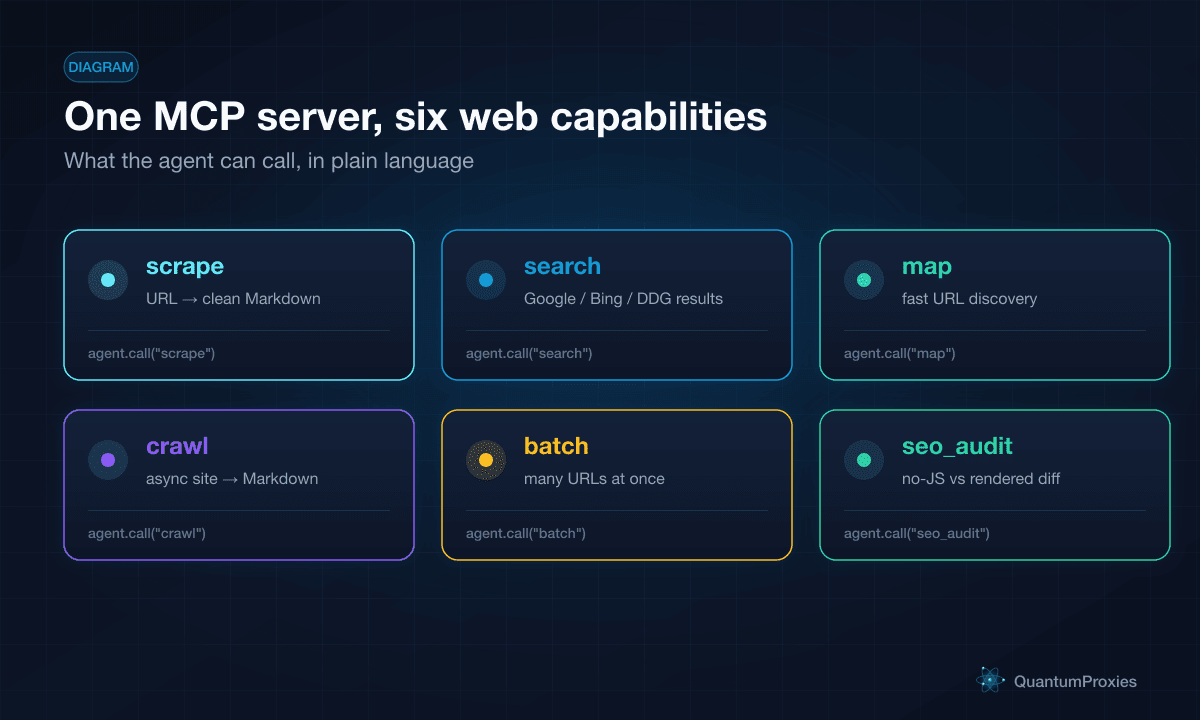
The QuantumProxies.io MCP server connects Claude, Cursor, and any MCP client to live web access through residential proxies with real-browser TLS fingerprints. It calls the public QuantumProxies Scraper API with your own key, so there are no internal secrets and you run it locally. It exposes the web as a set of tools an agent can call directly:
- scrape — fetch one URL as clean Markdown, HTML, or text; TLS-first, escalating to a browser only on challenge; with optional CSS or AI extraction.
- search — structured Google, Bing, or DuckDuckGo results across web, shopping, news, and images.
- map — fast URL discovery from sitemaps and homepage links, no full crawl needed.
- crawl / crawl_status — asynchronous site crawl to Markdown per page, with progress polling.
- batch / batch_status — scrape many URLs asynchronously, with incremental polling.
- seo_audit — fetch a URL as a no-JS bot and fully rendered, returning both views plus the diff.
Because it speaks MCP, wiring it into an agent is a single command. In Claude Code:
claude mcp add quantumproxies \
  -e QUANTUMPROXIES_API_KEY=qp_live_your_key_here \
  -- npx -y quantumproxies-mcp
For Claude Desktop, Cursor, or any other MCP client, the same server drops into the standard config file:
{
  "mcpServers": {
    "quantumproxies": {
      "command": "npx",
      "args": ["-y", "quantumproxies-mcp"],
      "env": { "QUANTUMPROXIES_API_KEY": "qp_live_your_key_here" }
    }
  }
}
Once connected, the agent can research a topic, pull competitor pages, check live prices, or audit a site's SEO mid-conversation — and every one of those requests goes out through a rotating residential exit that looks like a real browser, so the pages that block ordinary bots come back clean.
The takeaway
MCP settled the question of how AI agents connect to tools: one open, now vendor-neutral standard with the whole industry behind it. That makes the interesting question no longer "how do I integrate" but "what do I connect." Live web access is the highest-leverage answer, because it is simultaneously the most useful capability an agent can have and the one it is worst at doing unaided. A proxy-backed MCP server closes that gap in a single command — turning the defended, JavaScript-heavy, anti-bot web into a clean tool your agent can simply call.