Choosing a SERP API for AI and SEO Tools in 2026: The Buyer's Guide
Google killed num=100 and made JavaScript mandatory — building your own SERP scraper got a lot harder. Here's how to choose a SERP API that actually powers an AI or SEO product: verticals, geo, JSON shape and real cost.
A SERP API turns search results into structured JSON your product can consume — you send a query and a location, and you get back organic listings, ads, the knowledge graph, local packs and more, already parsed. It exists because scraping Google directly got much harder: Google retired the num=100 parameter that let one request pull 100 results, and it increasingly requires JavaScript execution, so rank tracking now costs several requests where it used to cost one. If you are building an AI or SEO tool in 2026, choosing the right SERP API is an infrastructure decision. Here is how to judge one.
What a SERP API actually does for you
Under the hood it handles the three things that make search scraping painful: it runs each query through a real browser and clean IP, it solves the challenges that would otherwise block you, and it parses the rendered page into stable structured data. That means you never rent proxies, never solve a CAPTCHA, and never write a parser that breaks when Google reshuffles its layout. The value is not the request — it is the guarantee that the JSON keeps arriving when the SERP changes shape.
The buyer's checklist
Score any SERP API against these criteria before you commit a product to it:
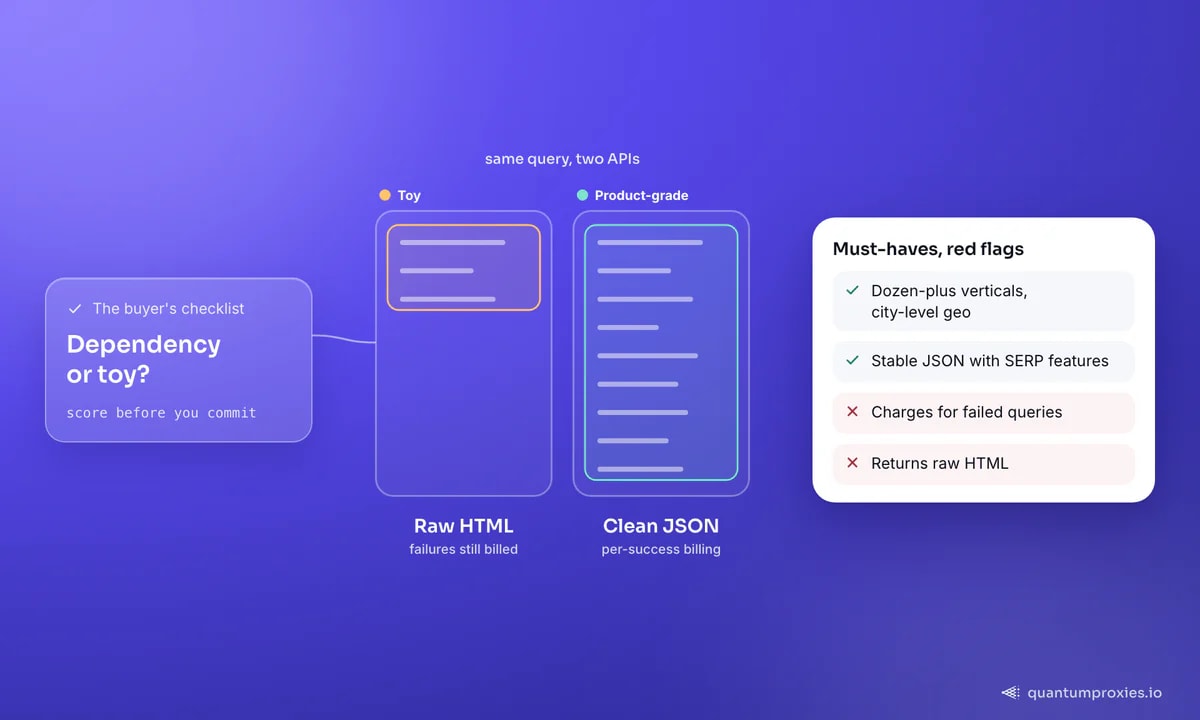
- Verticals — not just organic, but news, images, shopping, maps, videos, scholar, jobs, autocomplete, hotels, flights, events and reviews.
- Geo targeting — down to city level, using Google's own geolocated parameters, not a coarse country flag.
- JSON shape — a stable schema with SERP features (knowledge graph, local pack, PAA, related searches), not raw HTML.
- Cost model — billing on successful queries only, so failures and empties never cost you.
- Throughput — real per-hour capacity and batch support, so you can scale a keyword set.
- Latency and SLA — live queries in a few seconds, backed by an uptime commitment.
- Compliance — SOC 2 and ISO 27001 posture, public-data-only sourcing.
Verticals matter more since num=100 died
When one request could pull 100 organic results, organic-only coverage was almost enough. Now that the deep result page is gone and modern SERPs are dominated by features — shopping carousels, local packs, video blocks, AI overviews — the vertical coverage of your SERP API defines what your product can see. An SEO tool that only reads ten blue links misses most of the page a user actually gets. A QuantumProxies SERP API query can target Google, Bing or DuckDuckGo and pull any of a dozen-plus verticals, which is what lets a single integration power rank tracking, price intelligence and local SEO at once. Our deep dive on how SERP scraping works after num=100 explains why this shift raised the bar.
Geo accuracy is the whole game for local
Search results differ by city, and for local SEO or price intelligence that difference is the product. A good SERP API uses Google's geolocated, encrypted location parameters and routes each request through an exit near the target location, so the results match what a real user there would see — not an approximation from a country-level IP. If you cannot pin a specific city, you cannot honestly claim to track local rankings. Combine that with the reviews and maps verticals and you can monitor a business's local presence market by market.
How per-query cost really works
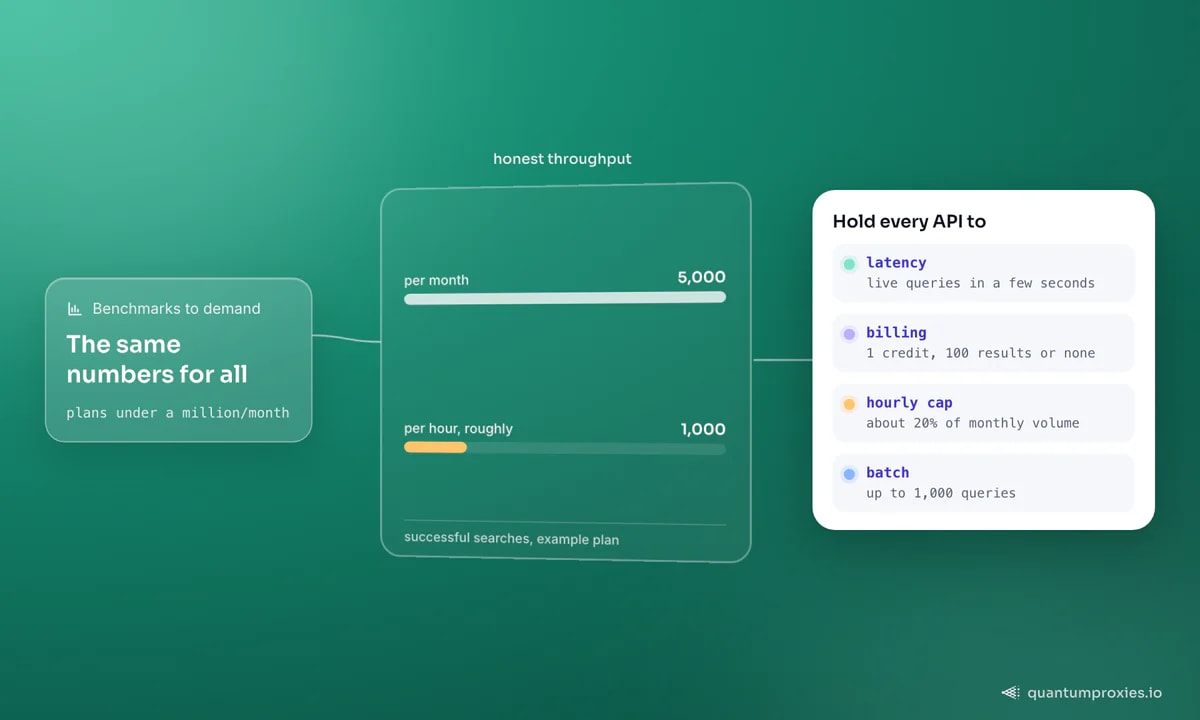
The headline price per thousand searches is only half the story; the counting rules decide your real bill. Insist on three things. First, only successful searches should count — cached, errored and failed queries must be free, or a bad day on the target becomes a bad day on your invoice. Second, credit cost should be independent of result volume: a response with 100 results and an empty one should both cost exactly one credit. Third, understand the throughput cap: for plans under a million searches a month, expect an hourly ceiling around 20% of your monthly volume, so a 5,000-per-month plan allows roughly 1,000 successful searches per hour. Spread queries evenly rather than bursting.
See the QuantumProxies SERP API and pricing
JSON shape for AI and SEO products
Your parser is the API's schema, so a clean, consistent JSON shape is worth more than a few milliseconds of latency. For an AI tool grounding answers in live search, you want organic results, the knowledge graph and any AI overview or featured snippet in predictable fields. For an SEO tool, you want positions, PAA questions and related searches so you can map intent. A single query looks like this:
curl -X POST "https://api.quantumproxies.io/v1/scraper/serp" \
  -H "Authorization: Bearer YOUR_API_KEY" \
  -H "Content-Type: application/json" \
  -d '{"query": "best running shoes", "engine": "google", "location": "Austin,Texas"}'
# -> structured JSON: organic, shopping, related_searches, people_also_ask
import requests
# a keyword set for a rank-tracker: one request per keyword
keywords = ["vpn deals", "best vpn", "cheap vpn 2026"]
for kw in keywords:
resp = requests.post("https://api.quantumproxies.io/v1/scraper/serp",
headers={"Authorization": "Bearer YOUR_API_KEY"},
json={"query": kw, "engine": "google", "location": "London,UK"},
timeout=120)
organic = resp.json()["payload"]["organic"]
print(kw, "->", organic[0]["rank"] if organic else None)If you are building a rank tracker on top of this, our tutorial on building your own rank tracker walks the full schema, and capturing AI Overviews covers the newest SERP feature to track.
Compliance you can put in front of a customer
If your product resells this data, the SERP API's compliance becomes yours. Look for SOC 2 Type II and ISO 27001 certification, a clear commitment to collecting only publicly accessible search data, and GDPR/CCPA alignment. This is general information, not legal advice, but a documented, audited provider is far easier to defend to an enterprise buyer than one with an opaque sourcing story.
Frequently asked questions
What is a SERP API?
A SERP API is a managed service that retrieves, renders and parses search engine results pages into structured JSON your application can consume. You send a query and location; it handles proxies, browser rendering and CAPTCHA solving, and returns organic results, ads, knowledge graph, local packs and other features as clean fields — so you never scrape Google directly.
How is SERP API pricing counted?
Good SERP APIs charge only for successful searches — cached, errored and failed queries are free — and cost is independent of result count, so a response with 100 results and an empty one both cost one credit. Watch the hourly throughput cap too: for plans under a million searches a month it is often around 20% of your monthly volume per hour.
Which SERP verticals should an SEO tool support?
At minimum organic, plus the features that now dominate the page: local pack and maps, shopping, news, images, videos, people-also-ask and related searches. Since Google removed num=100 and leaned into SERP features, organic-only coverage misses most of what a real searcher sees. Broad vertical support is what lets one integration serve rank tracking, local SEO and price intelligence.
Can I use a SERP API to ground an AI product?
Yes — a SERP API is a common grounding source for AI answers, giving live organic results, knowledge graph data and AI Overview or featured-snippet content in structured form. Choose one with low, consistent latency (live queries in a few seconds), a stable JSON schema, and batch support so you can fetch many queries per request without bursting past the throughput cap.
Judge a SERP API on verticals, city-level geo, clean JSON, per-success billing, honest throughput and a compliance story you can show a customer. Get those right and one integration powers rank tracking, local SEO, price intelligence and AI grounding from a single JSON shape.