Scraping Crypto and NFT Market Data Beyond the Exchange APIs
Exchange APIs are rate-limited and only cover the coins they list. DEX pairs, NFT floors and mint calendars live on JS-heavy pages behind bot detection. Here's how to collect all of it reliably.
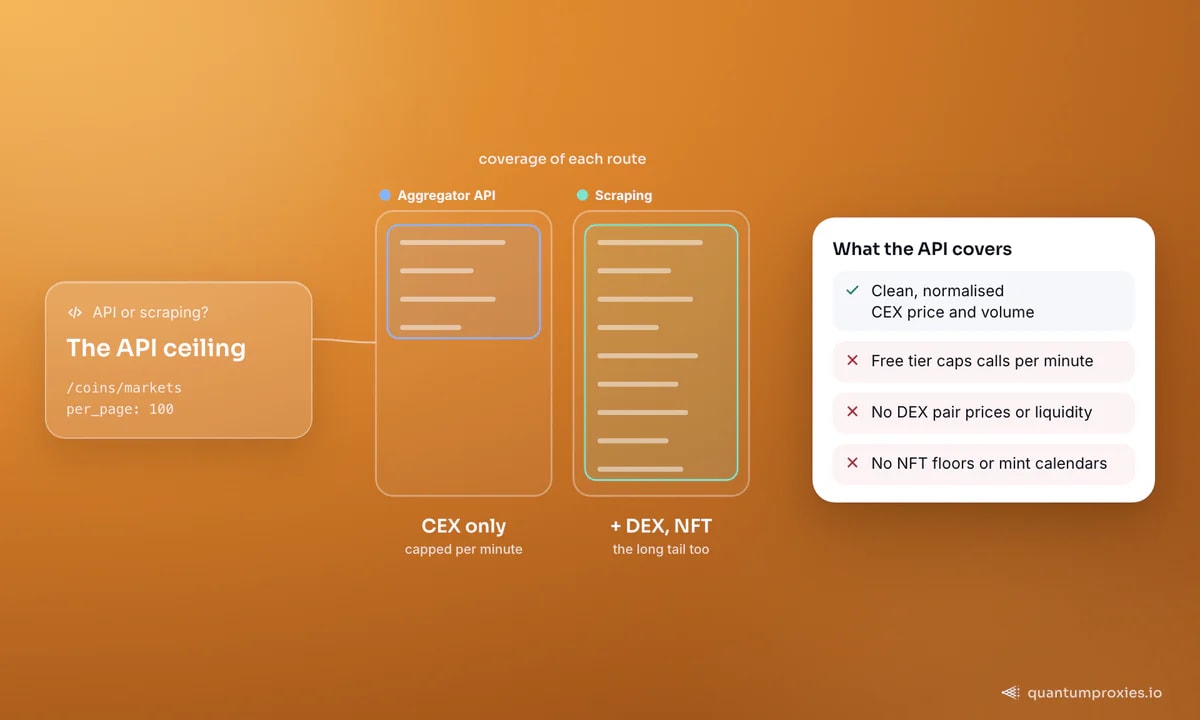
Crypto market data looks like it should be easy — surely every exchange has an API? They do, but those APIs are rate-limited, cover only the assets that exchange lists, and say nothing about the two places where a lot of the alpha lives: decentralised exchange (DEX) pairs and NFT marketplaces. If you're building a price tracker, a listing bot, or an alt-data feed, you'll hit the API ceiling fast and have to scrape the rest. This guide covers the layers of crypto and NFT data, when to use an API versus scraping, and the proxy setup that keeps a real-time feed running. It's about data collection, not investment advice.
Three layers of market data
Think of the data in three tiers. Centralised exchange and aggregator data — price, market cap, circulating supply, 24h volume, and 1h/24h/7d change — is what sites like CoinMarketCap and CoinGecko surface, and it's the easiest to get. DEX data — live pair prices, liquidity, new listings — lives on JavaScript-rendered pages and rarely has a clean free API. NFT data — floor prices, listing counts, mint calendars — sits on marketplace pages that render client-side and run bot detection. Most projects need at least two of these tiers, which is why an API alone never covers you.
Start with the aggregator API
For top-of-book CEX data, use a public aggregator API first — it's free JSON, fast, and already normalised. The catch is the rate limit: free tiers cap you at a modest number of calls per minute, which falls apart the moment you poll hundreds of assets frequently. Pull the bulk snapshot in as few calls as possible, then scrape the long tail the API doesn't cover.
import requests

# one call returns the top 100 by market cap, already normalised
r = requests.get(
    "https://api.coingecko.com/api/v3/coins/markets",
    params={"vs_currency": "usd", "order": "market_cap_desc",
            "per_page": 100, "page": 1},
    timeout=15,
)
for c in r.json()[:5]:
    print(c["symbol"], c["current_price"],
          c["total_volume"], c["price_change_percentage_24h"])
When you outgrow the free rate limit, spread requests across rotating IPs so the per-IP cap stops being your ceiling. Because aggregator endpoints are API-like and lenient, fast datacenter proxies are the economical choice here — cheap, quick, and enough to parallelise polling without tripping limits.
DEX pairs and exchange pages: render the JavaScript
DEX pair pages and many exchange market pages draw their prices and charts with JavaScript behind aggressive bot detection — a raw HTTP request gets an empty shell. To read live pair prices, liquidity or a token's full trading view, you render the page in a headless browser routed through a proxy. Wait for the price element rather than a fixed sleep, and rotate the exit IP per run so the endpoint doesn't fingerprint a repeating visitor.
from playwright.sync_api import sync_playwright

PROXY = {"server": "http://residentialpremium.quantumproxies.io:8080",
         "username": "USER", "password": "PASS"}

def pair_price(url, selector):
    with sync_playwright() as p:
        browser = p.chromium.launch(proxy=PROXY)
        page = browser.new_page()
        page.goto(url, wait_until="networkidle", timeout=30000)
        page.wait_for_selector(selector)          # wait for the price to render
        price = page.inner_text(selector)
        browser.close()
        return price
If you're rendering many of these, maintaining a browser fleet plus proxy rotation gets heavy. A Scraper API renders the JavaScript, defeats the bot layer and returns clean data in one call — our note on scraping JavaScript-heavy sites explains when to switch.
Render JS-heavy crypto pages with Scraper API
NFT floors and mint calendars
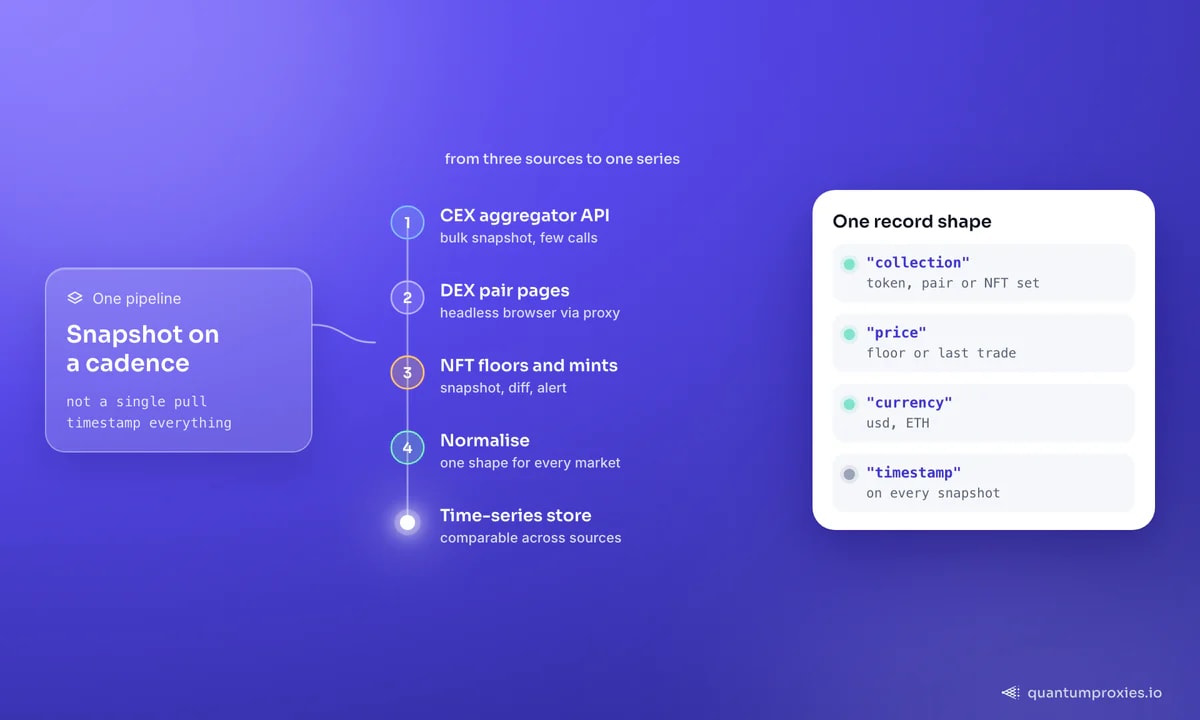
NFT data is what listing bots and floor-sweepers run on: the current floor price of a collection, how many are listed, and when new mints go live. Marketplace pages render client-side, so the reliable approach is to snapshot a collection's floor on a tight schedule and diff it — a drop in the floor or a spike in listings is the signal traders act on. Mint calendars are the same pattern applied to upcoming drops: poll the calendar, capture new entries, and alert on the ones you care about.
import time

def watch_floor(collection_url, selector, interval=60):
    last = None
    while True:
        floor = float(pair_price(collection_url, selector).strip(" ETH"))
        if last is not None and floor < last:
            print(f"floor dropped {last} -> {floor}")   # act on the dip
        last = floor
        time.sleep(interval)                              # snapshot cadence
This is where listing bots live or die on their data. A sniping bot that reacts to a floor drop or a new listing is only as fast as its feed, and a feed that's rate-limited or getting blocked is worthless. The bots that win poll their target collections aggressively, from clean rotating IPs, and normalise everything into one shape — collection, price, currency, timestamp — so a drop is comparable across marketplaces. The scraping problem and the trading problem are the same problem: keep the data fresh and never get shut out of the source.
Which proxies for which layer
Match the proxy to the target. Aggregator and public JSON endpoints are lenient — fast, cheap datacenter proxies with rotation handle them and keep your per-GB costs low. DEX pages, exchange market views and NFT marketplaces run real bot detection, so those want residential IPs or a Scraper API that carries a browser fingerprint. The mistake to avoid is paying for residential bandwidth on endpoints that would happily serve a datacenter IP — that's covered in our guide to when datacenter proxies win. And because these feeds power alt-data strategies, the same collection discipline from our alt-data for funds guide applies: timestamp everything and snapshot on a fixed cadence.
Frequently asked questions
Why scrape crypto data when exchanges have APIs?
Exchange APIs are rate-limited and only cover the assets that exchange lists. They don't expose DEX pair prices, NFT floor prices or mint calendars, and free tiers cap your call volume. Scraping fills those gaps — the long tail of tokens, decentralised markets and marketplace data — and lets you aggregate across sources the APIs never connect.
Do I need proxies to scrape crypto and NFT data?
For light use of a public API, no. For frequent polling or scraping DEX and NFT pages, yes. Aggregator endpoints cap you per IP, so rotating datacenter proxies raise your throughput. DEX and marketplace pages run bot detection, which needs residential IPs or a Scraper API that renders JavaScript and carries a browser fingerprint.
How do I scrape NFT floor prices?
Marketplace collection pages render client-side, so render the page in a headless browser through a proxy, wait for the floor-price element, and snapshot it on a schedule. Diff consecutive snapshots to catch drops and listing spikes. Rotate exit IPs per run and pace your polling so the marketplace doesn't flag a repeating visitor.
How often should I snapshot crypto prices?
It depends on the use case. Portfolio tracking is fine at minutes; DEX and NFT floor monitoring for trading signals often wants tighter intervals, down to seconds for the most active pairs. Faster polling raises your request volume and block risk, so spread it across rotating IPs and store timestamps to reconstruct the series.
Crypto and NFT market data spans three tiers — CEX aggregators, DEX pairs, NFT floors and mints — and no single API covers them. Start with the aggregator for clean CEX snapshots, render the JS-heavy DEX and marketplace pages through proxies, and match the proxy type to how guarded each target is: cheap datacenter IPs for lenient JSON, residential or a Scraper API for the guarded pages. Snapshot on a cadence, timestamp everything, normalise into one shape, and you have a feed that sees the whole market, not just the coins one exchange happens to list.