Types of Proxies and Web Data APIs: The Complete Guide to Every QuantumProxies Service
Four proxy types, three search engines, one scraping API and a free IP fraud-score checker. Here's the full map of every QuantumProxies service — what each one is, how it works, and which job it wins.
Search for 'types of proxies' and you will find lists of twenty-six categories that mix up protocols, anonymity levels and IP sources until nothing means anything. In practice the choice is much simpler. Proxies differ on one axis that matters — where the IP address comes from — and every other split (rotating vs static, HTTP vs SOCKS5) is a configuration detail on top. This guide walks through the four main proxy types, the two configuration splits, and the data APIs that sit above them: a SERP API for search results, a scraping API for any other page, and a free IP quality score checker to test the IPs you are using. It is also a complete map of what QuantumProxies offers, so you can match each service to the job it actually wins.
The four main types of proxies, by IP source
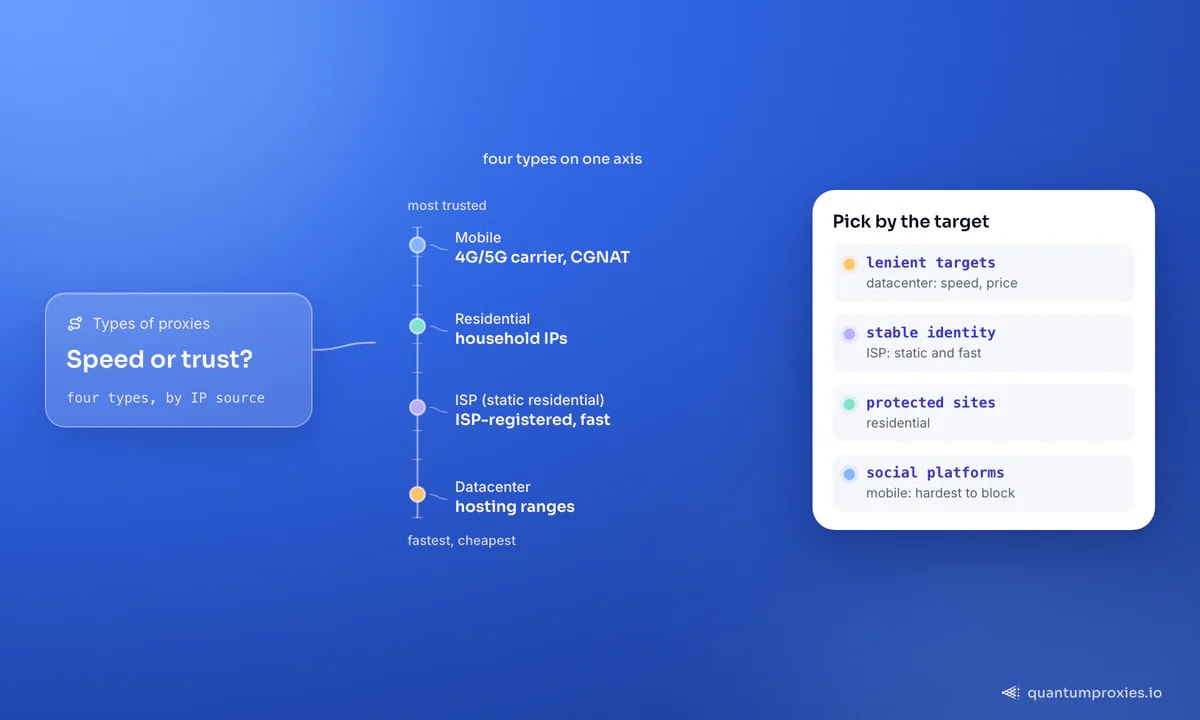
Every proxy hands your request a different IP address. What the target website does next depends almost entirely on whose IP it is. An address registered to a home internet provider gets treated like a person; an address registered to a hosting company gets treated like a script. That single fact creates the trust-versus-speed spectrum all four proxy types live on.
Residential proxies
Residential proxies route your traffic through real household IPs assigned by consumer internet providers. To the target site, each request is indistinguishable from a person browsing at home — which is why residential proxies post the highest success rates on protected sites and are the default choice for web scraping, price monitoring, ad verification and multi-account work. QuantumProxies runs a pool of 90M+ residential IPs across 200+ countries, with country and city targeting, per-request rotation or sticky sessions, and pay-per-GB billing.
ISP proxies (static residential)
ISP proxies are the hybrid: hosted on datacenter hardware for speed, but registered under a real internet service provider, so they carry residential-grade trust. They are static — you keep the same IP for as long as you need it — and fast, which makes them the pick for checkout races, long-lived logged-in sessions and SEO tools that need a stable identity.
Mobile proxies
Mobile proxies use 4G/5G carrier IPs. Because mobile carriers put thousands of real subscribers behind each address (CGNAT), platforms cannot block a mobile IP without locking out real customers — which makes mobile the most trusted proxy type in existence. They are the standard for social platforms like Instagram and TikTok, mobile ad verification, and app testing.
Datacenter proxies
Datacenter proxies come from commercial hosting ranges. They are the fastest and cheapest type, and the easiest to detect — protected sites recognize hosting ASNs instantly. Use them for volume work on lenient targets: public APIs, internal QA, uptime checks, and sites that don't fight automation. When a datacenter IP works, nothing beats its price per request.
IPv6 proxies
IPv6 proxies deserve their own line because the economics are different: IPv6 address space is so large that pools are enormous and prices are a fraction of IPv4. The catch is that the target must actually support IPv6 — many sites still don't. Test your target with a free IPv6 compatibility checker first; if it passes, IPv6 is the cheapest clean traffic you can buy.
Rotating vs static, HTTP vs SOCKS5
The other two splits people call 'proxy types' are really settings, and you should pick them per job, not per vendor:
- Rotating proxies — a new IP from the pool on every request (or every few minutes), so a thousand requests look like a thousand visitors. The default for scraping and data collection.
- Sticky sessions — one IP held for a set window (e.g. 10 minutes), for flows that span several requests: logins, carts, forms.
- Static proxies — one dedicated IP, yours indefinitely. What ISP and datacenter plans provide for stable identities.
- HTTP(S) vs SOCKS5 — HTTP proxies understand web traffic and are what browsers and most scrapers expect; a SOCKS5 proxy forwards any TCP connection, which is what bots, custom clients and non-web protocols need.
Every QuantumProxies plan includes rotation, sticky sessions and both protocols out of the box — the endpoint string decides the behavior, so switching modes is a one-line change, not a new purchase.
SERP API: search results as structured JSON
A SERP API returns live search engine results as structured data. Instead of running browsers, rotating proxies and parsing HTML that changes weekly — Google now requires JavaScript execution to even render results — you send one HTTP request with a query and get back parsed JSON: organic results with ranks, ads, People Also Ask, related searches, knowledge panels. The QuantumProxies SERP API covers Google, Bing and DuckDuckGo, and Google verticals well beyond web search: news, images, shopping, maps and places, videos, scholar, jobs, hotels, flights, events and autocomplete.
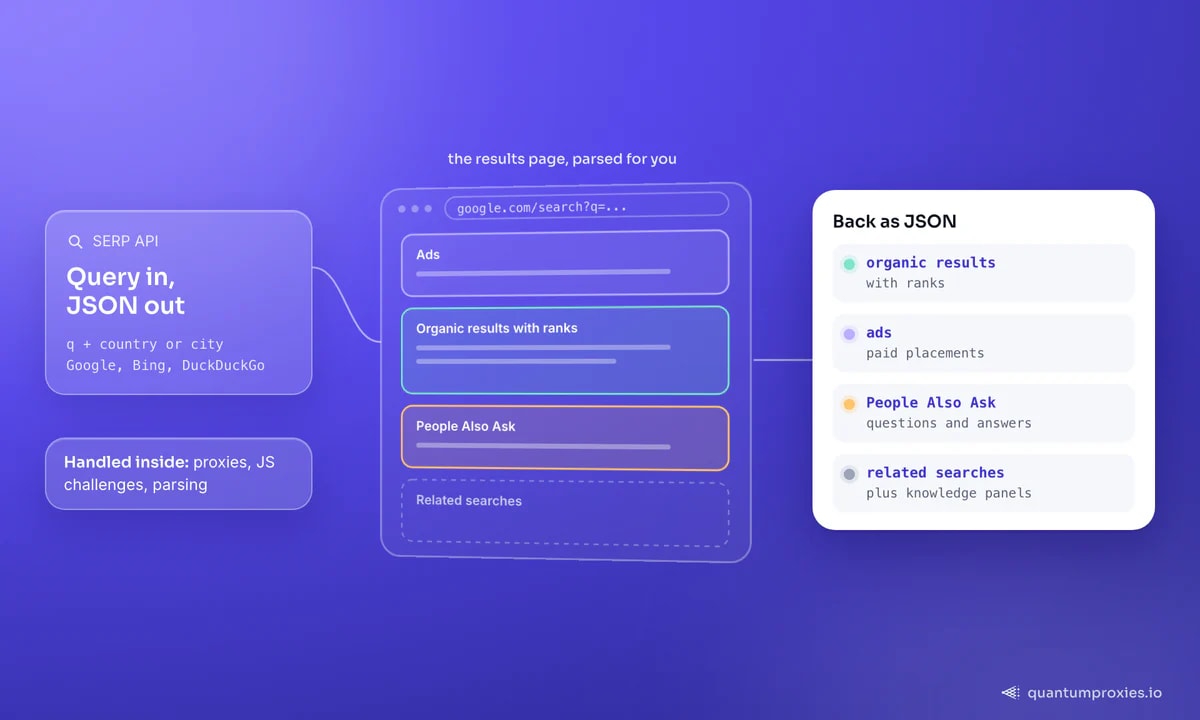
Every query is geo-targetable by country or city, which is what makes the classic use cases work: rank tracking that sees what a searcher in Milan or Dallas sees, keyword research at scale, competitor and brand monitoring, and grounding AI answers in live search results. If you have ever tried to scrape Google directly, you know the block rate; the API exists so you never fight that war yourself.
Scraper API and web data for LLMs
The SERP API's sibling handles every page that isn't a search engine. The Scraper API fetches any URL through the residential network, renders JavaScript when needed, and returns clean output — LLM-ready markdown, structured JSON via CSS selectors or an AI extraction prompt, or raw HTML if you want it. Around the single-page endpoint sit the bulk tools: crawl a whole site, map its URLs, run batches, and build datasets. And because AI agents are the fastest-growing consumer of web data, the same capabilities ship as an MCP server — so Claude, Cursor or any Model Context Protocol client gets live, unblockable web access and fresh search results as native tools.
If you are feeding a RAG pipeline or grounding an LLM, this is the practical difference: markdown that drops straight into a context window, instead of HTML soup you clean up yourself.
IP quality score: check any IP before it burns a job
An IP quality score (also called a fraud score or IP reputation score) is a 0–100 risk rating that fraud-detection systems assign to every address, based on whether it appears in proxy and VPN databases, sits on spam blacklists, or shows abusive history. Websites buy these scores to decide who gets blocked — which means you should check your own IPs against the same standard before trusting them with real work. QuantumProxies offers a free IP quality score checker: paste any IP and get its fraud score, proxy/VPN detection status and blacklist listings in seconds.
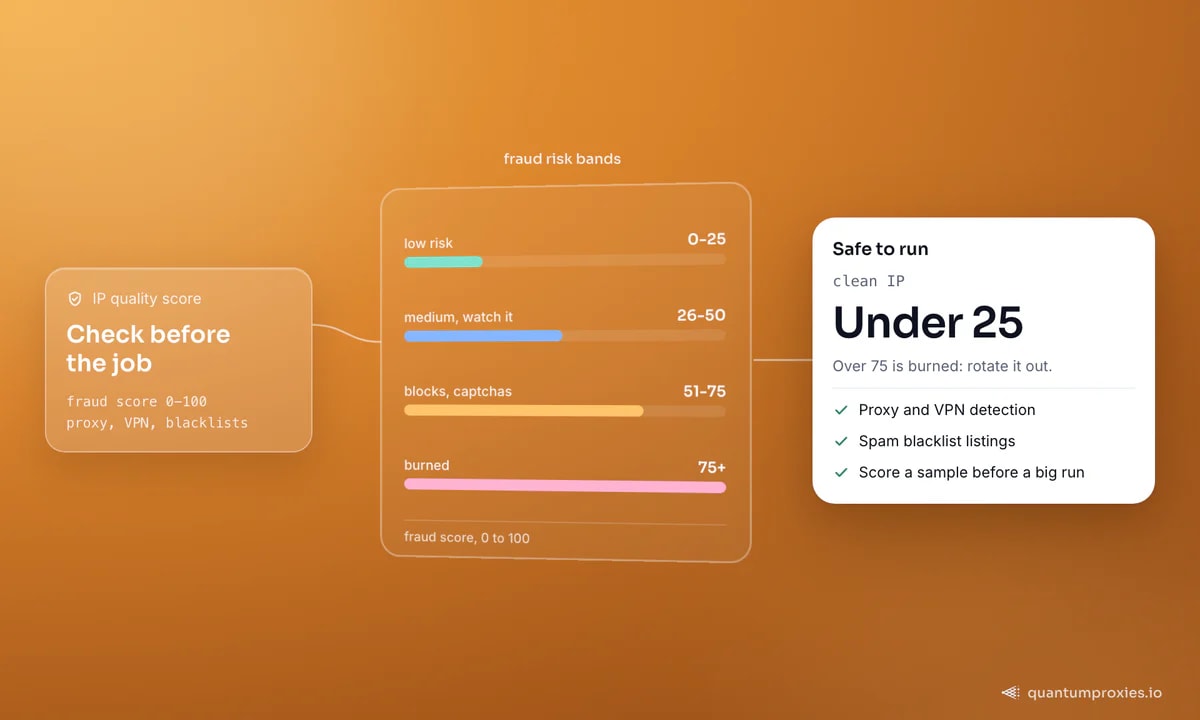
A practical routine: score a sample of your proxy pool before a big run, drop anything above the medium-risk band, and re-check IPs that start collecting blocks. A score under 25 is low risk and safe to run; 75+ means the address is burned — rotate it out.
Check any IP free with the IP quality score tool
Which service wins which job
- Web scraping and price monitoring: residential proxies, or the Scraper API if you'd rather skip parsing and anti-bot work entirely.
- SEO rank tracking and keyword research: SERP API, geo-targeted per market.
- Sneaker and retail drops: ISP proxies for the speed race, residential for trust-heavy storefronts.
- Social media and multi-account management: mobile proxies, one clean carrier IP per account.
- Ad verification: residential and mobile proxies, geo-matched to the campaign.
- AI agents and LLM data pipelines: the MCP server plus the Scraper API's markdown output.
- High-volume work on lenient targets: datacenter proxies, or IPv6 if the target supports it.
- Auditing the IPs you already have: the free IP quality score checker.
Frequently asked questions
How many types of proxies are there?
By IP source — the classification that matters — there are four: residential, ISP, mobile and datacenter, with IPv6 as a price-driven fifth. Longer lists you see elsewhere are counting the same proxies again by protocol (HTTP, SOCKS5), rotation (rotating, static) or direction (forward, reverse).
What is the difference between residential and datacenter proxies?
The IP's owner. Residential IPs belong to consumer internet providers and look like real people, so protected sites let them through — success rates on hard targets commonly sit above 95%. Datacenter IPs belong to hosting companies, are flagged on sight by serious anti-bot systems, but cost far less and run faster where they are tolerated.
What is a SERP API?
A SERP API (search engine results page API) is a service that fetches live search results and returns them as structured JSON, handling proxies, JavaScript challenges and parsing internally. You send a query and a location; you get back ranked organic results, ads, and SERP features ready for a database or an AI pipeline.
What is a good IP quality score?
Lower is better: 0–25 is low risk and safe for real work, 26–50 is medium and worth watching, 51–75 will start hitting blocks and captchas, and above 75 the IP is effectively burned. Premium residential and mobile IPs typically score in the low band because they belong to real consumer networks.
Are rotating proxies better than static proxies?
Neither is better — they solve different problems. Rotation spreads volume across thousands of IPs, which is what scraping needs. A static IP builds a consistent identity, which is what logged-in accounts and checkout flows need. Good setups use both, per task.
That is the whole map: four proxy types on a trust-speed spectrum, rotation and protocol as per-job settings, two APIs so search results and web pages arrive as clean data, and a free checker to audit any IP you touch. Start with the job, pick the leftmost tool that wins it, and you will never overpay for trust you don't need — or burn a project on trust you didn't buy.