Scraping Travel & Airfare Prices: Why Location Is Everything
The same flight costs different amounts depending on where the site thinks you are booking from. That single fact breaks naive fare scraping — and it's exactly why travel data teams live and die by geo-targeted proxies. Here's how it really works.
Travel is the most aggressively dynamic pricing market on the internet. A flight fare can change several times a day; a hotel rate moves with occupancy and the calendar. But travel has a second twist that ordinary retail does not: the price you are quoted depends heavily on where the booking appears to originate. The same seat, on the same flight, on the same day, can cost noticeably different amounts depending on the point-of-sale country, currency, and even the cookies in the browser. That single fact is why fare scraping is deceptively hard — and why every serious travel data team is really a proxy operation in disguise.
Whether you are a metasearch or online travel agency aggregating fares from hundreds of sources, a travel brand benchmarking competitors, or an analyst modelling price trends, the job is the same: collect accurate, comparable prices at scale and at speed. Get the location wrong and you are not collecting noisy data — you are collecting confidently wrong data, which is worse. Here is what actually changes fares, and how to collect them cleanly.
Why the same fare shows different prices
Travel sites personalize price on signals that have nothing to do with the flight itself:
- Point of sale — airlines and OTAs file different fares for different markets. The same route can be cheaper booked "from" one country than another.
- Currency and taxes — the displayed price shifts with local currency, regional taxes, and fees, so a naive USD scrape misrepresents the local reality.
- Device and session — mobile versus desktop, and a fresh session versus one carrying cookies, can surface different prices and promotions.
- Demand and timing — inventory and dynamic pricing move fares by the hour, so stale data is useless data.
The consequence is unavoidable: to know what a traveler in Tokyo, London, or New York actually pays, you have to appear to be booking from Tokyo, London, or New York. There is no shortcut that skips location.

Why travel sites are hard to scrape
Fares also happen to sit behind some of the most defensive infrastructure on the web, because the data is valuable and the sites know it.
Aggressive anti-bot defenses
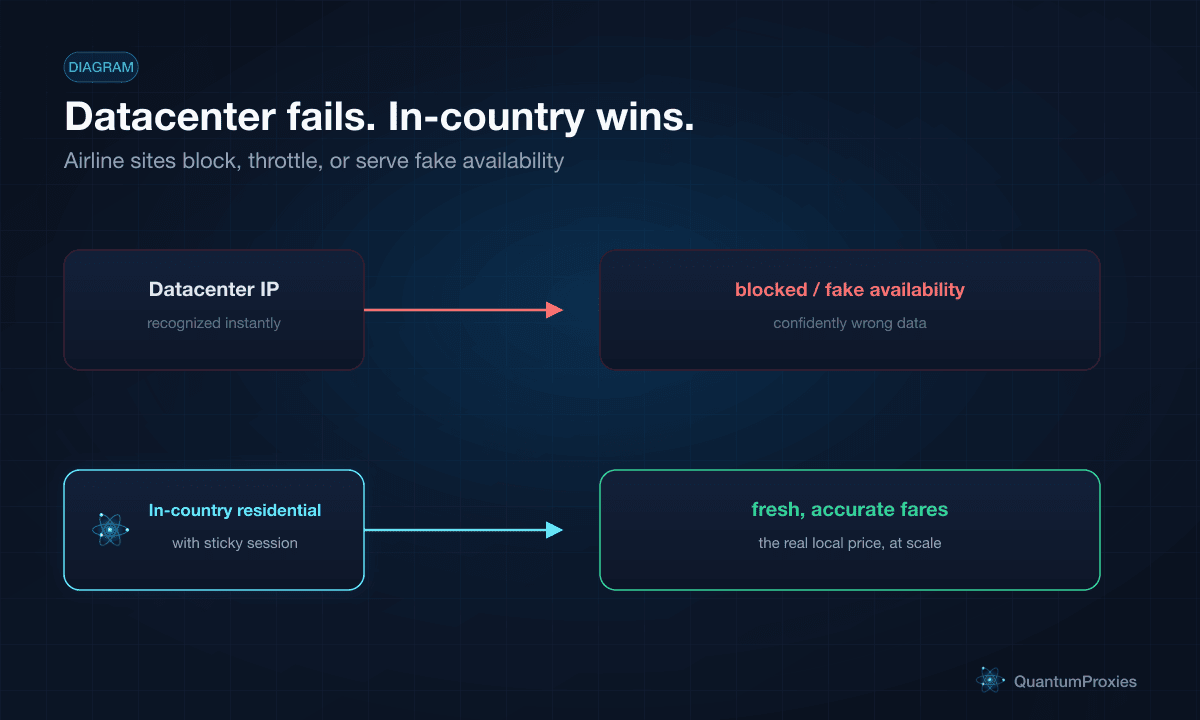
Airline and OTA sites lean hard on bot detection. Datacenter IPs are recognized and blocked quickly, and repetitive querying from one address gets throttled or served fake availability. Collecting fares at the scale a real fare feed needs is precisely the behavior these systems are built to stop.
JavaScript-heavy, session-based results
Fare results are typically assembled dynamically after a search, often behind multiple steps and a live session. A fetch that cannot hold a consistent session or execute the page ends up with empty or partial results — no prices at all.
Freshness pressure
Because fares move constantly, you need to re-collect often, which multiplies request volume and, with it, the block surface. Freshness and scale pull against each other unless your collection layer can absorb the load without tripping detection.
How proxies make fare data reliable
Geo-targeted proxies solve the core problem — location — and the scale problem at the same time:
- Residential proxies in each target country let you read the true point-of-sale fare a local traveler sees, in the right currency and with the right regional pricing.
- Broad country and city coverage means you can benchmark the same route across every market that matters, not just the one you happen to sit in.
- Rotation across a large pool spreads high-frequency fare checks so no single IP trips the airline's rate limits, keeping your feed fresh without getting cut off.
- Sticky sessions hold one IP through a multi-step search flow, so a single fare query completes cleanly instead of breaking mid-session.
For the toughest airline and OTA pages, pairing residential IPs with a scraper that executes JavaScript and manages the session is what turns "blocked" into a clean, structured fare — collected from exactly the market you are pricing for.
How QuantumProxies fits
Travel data is a location problem before it is a scraping problem, and location is what QuantumProxies is built around: residential IPs across 200+ countries with city-level targeting, so you can read the true fare in every point-of-sale market. Rotation and sticky sessions keep high-frequency collection fresh and session-safe, and when a fare page fights back, the network powers a Scraper API that renders JavaScript and holds the session for you.
That means you can benchmark a route across a dozen markets, feed a price-comparison product, or model fare trends — all on data that is actually local and actually current, instead of one distorted view from wherever your servers happen to live.
Explore geo-targeted proxies for travel data
Start with a free trial, pick the markets you price for, and collect fares the way your travelers actually see them. In travel, the difference between accurate and useless data is usually one thing: where the request came from.