Scraping Real Estate Data: Listings, Comps & Market Signals at Scale
Every property decision — a comp, an offer, an investment model — runs on data that lives on listing portals built to block scrapers. Here's how proptech teams and investors collect real estate data at scale without getting cut off.
Behind every confident property decision is a pile of data. A realistic comp, a fair offer, an investment model, a lead list of motivated sellers — all of it is built from listings, prices, price cuts, days-on-market, and how those numbers move over time. And nearly all of that data lives on a handful of listing portals that treat it as their crown jewels and defend it accordingly. The information is public in the sense that anyone can browse it; it is anything but easy to collect at the scale a real analysis or product needs.
That is the gap proptech teams, investors, and analysts have to bridge: turning listings scattered across defended portals into a structured, current dataset they can actually model. Whether you are pricing comps, sourcing off-market leads, feeding an AVM, or tracking a market's temperature, the job comes down to collecting property data reliably and repeatedly without getting blocked. Here is how that works in practice.
What property data drives
Listing and market data is the raw material for decisions across the whole industry:
- Comparables and valuation — accurate comps and AVMs need current listings, sold prices, and property attributes across a whole area, not the three houses you found by hand.
- Market signals — inventory levels, price cuts, and days-on-market are a live read on whether a market is heating up or cooling down, weeks before it shows in a report.
- Lead generation — new, stale, or for-sale-by-owner listings are a real-time pipeline of motivated sellers for agents and investors.
- Product data — portals, CRMs, and analytics tools are only as good as the fresh listing feed underneath them.
Every one of these needs breadth and freshness — a whole market, kept current — which is exactly what you cannot get by browsing manually or checking a single IP against a portal that fights back.

Why listing portals are hard to scrape
Property portals know their data is valuable, so they defend it with some of the most aggressive anti-bot measures on the consumer web.
Heavy anti-bot defenses
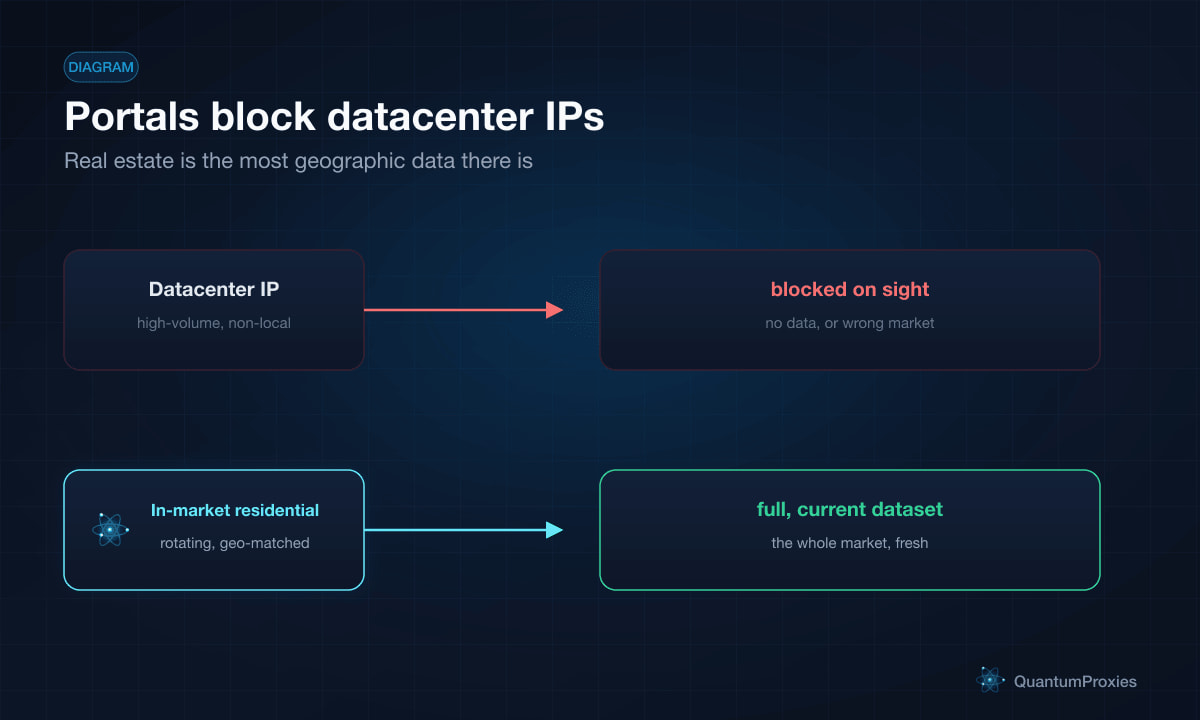
Major listing sites block datacenter IPs on sight and throttle anything that looks automated. Collecting a whole market's listings is inherently high-volume, which is exactly the behavior these systems are tuned to detect and stop.
Data is strictly local
Real estate is the most geographic data there is. Listings, availability, and even which portal dominates change by country and region, so accurate collection requires requests that appear to come from the market you are analyzing — a US datacenter cannot reliably read the London or Sydney market.
Freshness is the whole point
A comp from last quarter or a lead that sold last week is worthless. Useful property data has to be re-collected constantly, which multiplies request volume and, with it, the block surface — freshness and scale pulling against each other unless your collection layer can absorb the load.
How proxies make it reliable
Geo-targeted, rotating proxies solve the two problems that break real estate scraping — defense and location — at the same time:
- Residential proxies use real home IPs that read as ordinary house-hunters, keeping a low block rate on portals that reject datacenter traffic instantly.
- Rotation across a large pool spreads whole-market collection so no single IP shows the high-volume pattern that triggers blocks — the key to covering an area, not a sample.
- Geo-targeting by country and city reads each local market accurately, so your comps and signals reflect the actual area you are pricing.
- Paired with a scraper that renders JavaScript and handles challenges, residential IPs turn a defended portal into clean, structured listing data on a schedule.
As always, collect responsibly: stick to publicly available listing information, respect each portal's terms and rate, and use the data for analysis and modelling. Property-market research is a mainstream, legitimate use of web data — the goal is a better model, not republishing someone's listings.
How QuantumProxies fits
Real estate data is a location-and-scale problem, and that is precisely what QuantumProxies is built for: residential IPs across 200+ countries with city-level targeting so you read each local market accurately, rotation so you can cover a whole area without tripping a portal's defenses, and a Scraper API that renders listing pages and clears challenges so defended portals return structured data.
Point it at the portals that matter in your markets, pull listings, prices, and days-on-market into your models or product on a schedule, and you have a fresh, full-coverage feed instead of a hand-collected sample that is stale by the time you use it.
Get geo-targeted proxies for property data
Start with a free trial, pick the markets you invest in or serve, and build your comps and signals on data that is actually complete and actually current. In real estate, the edge goes to whoever sees the whole market first — and that starts with being able to collect it.