B2B Lead Generation at Scale: How to Scrape Clean Prospect Data
Your ideal customers are already listed publicly — on Google Maps, in directories, on their own sites. The bottleneck isn't finding them, it's collecting that data at scale without getting blocked or drowning in junk. Here's the playbook.
Every sales team hits the same wall: the pipeline is only as good as the list at the top of it. And here is the quietly frustrating part — your ideal customers are already listed publicly. They are on Google Maps, in industry directories, on their own websites, on professional networks. The prospects exist. The bottleneck is never finding that one company; it is collecting thousands of them, with clean and current contact data, faster than a human ever could, without getting blocked halfway through.
That is exactly what lead-generation scraping does: it automates the collection of publicly available company, contact, category, location, and market-signal data from the places your prospects already live online. Done well, it turns a week of manual copy-paste into a filtered, sales-ready list. Done naively, it gets your IP banned on page two and fills your CRM with junk. The difference between those two outcomes is mostly infrastructure — and this is the practical guide to getting it right.
Where the good leads actually live
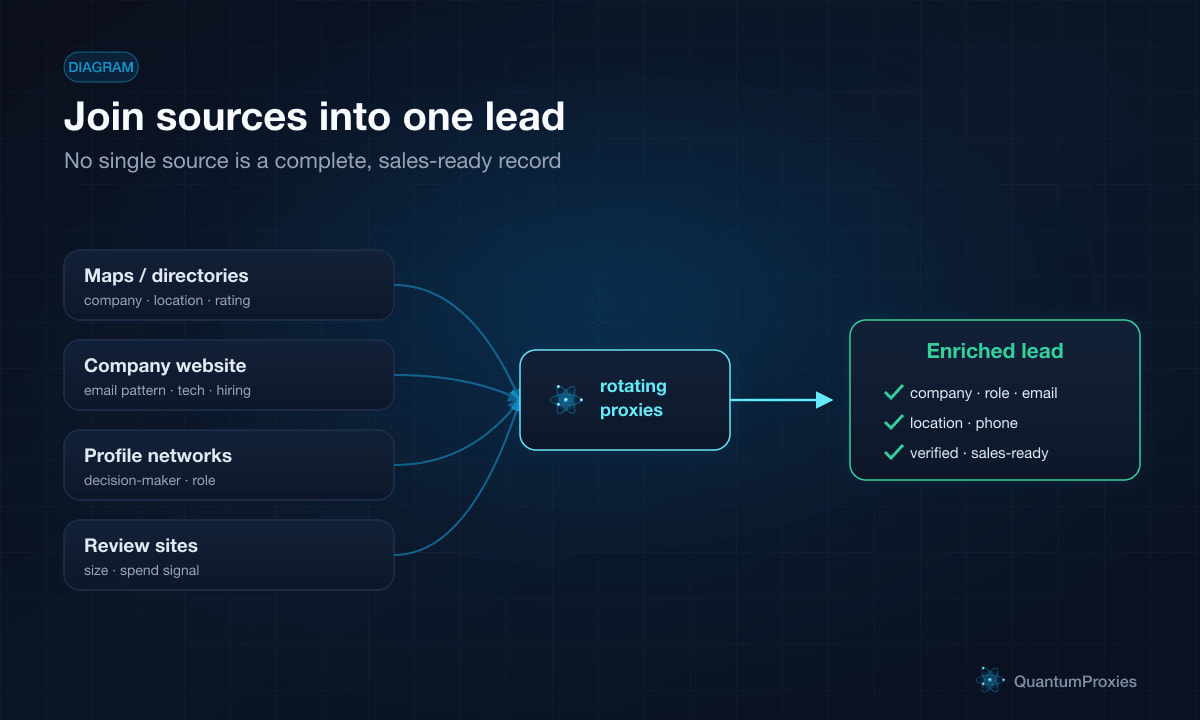
You do not scrape "the internet" for leads — you scrape a handful of high-signal sources and join them together:
- Business directories and maps — Google Maps and vertical directories give you company name, category, location, phone, hours, and ratings. Filter by city, business type, and rating to build a targeted list of, say, every dental clinic in three metros.
- Company websites — the source of truth for the email format, the team page, the tech they mention, and whether they are hiring (a strong buying signal).
- Professional networks and profiles — role, seniority, and the decision-maker behind the company, so you are emailing a person, not an inbox.
- Marketplaces and review sites — for sellers and local businesses, presence and review volume are a proxy for size and spend.
The magic is in the join. One source rarely gives you a complete lead; the company from Maps, the email pattern from the website, and the decision-maker from a profile network together become a record worth emailing. Collecting all three at scale is where the technical challenge starts.
Why lead scraping breaks at volume
Scraping ten companies by hand is trivial. Scraping ten thousand across dozens of cities is where the walls go up.
IP bans and rate limits
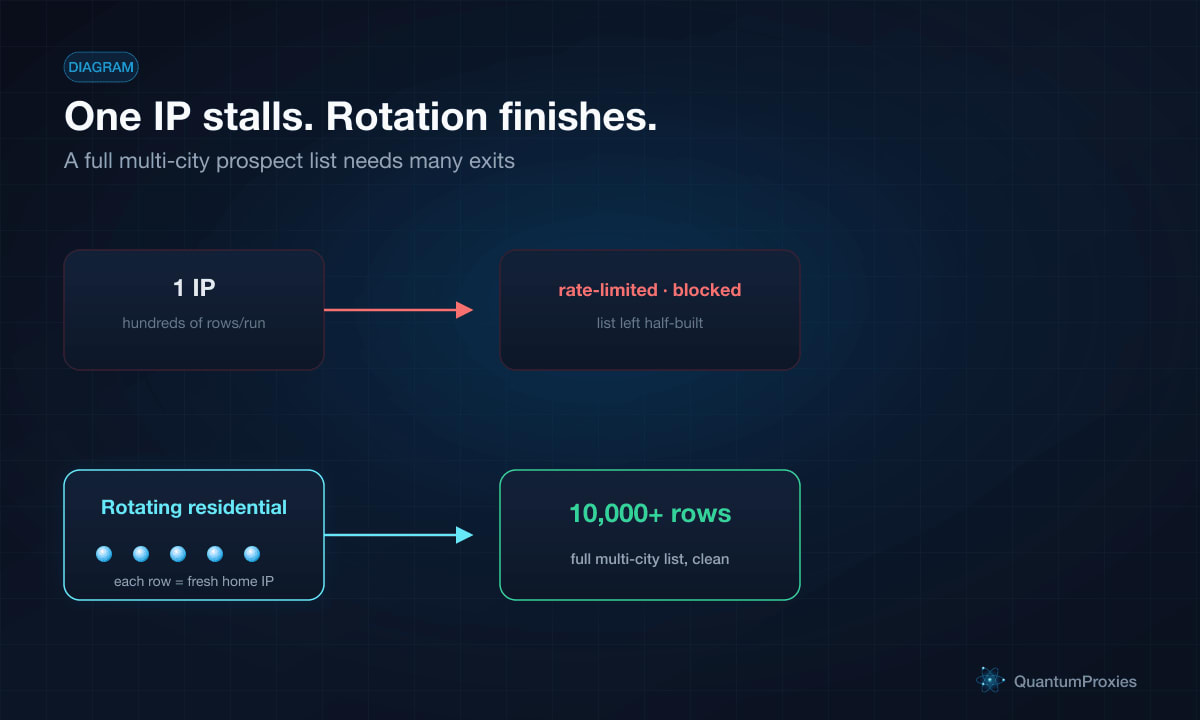
Directories and maps watch for exactly the pattern a scraper creates: one IP requesting hundreds of listings on a schedule. From a single address you get rate-limited, throttled, or blocked within a few hundred requests — right as you are getting to the volume that makes the whole exercise worthwhile.
Geo-gated local data
Local business results depend on where the request appears to come from. Search for "marketing agencies" from a US datacenter and you will not reliably see the London, Berlin, or Sydney results you actually want. To build a list for a specific market, your requests have to originate there.
Junk in, junk out
The other failure mode is quieter: incomplete or blocked pages return partial records, and a CRM full of missing emails and dead phone numbers is worse than no list at all. Reliable collection is the difference between a list your reps trust and one they quietly ignore.
How proxies make it work
A proxy routes each request through a different IP, so the source sees ordinary visitors instead of one machine on a timer. For lead generation, that solves the two hard walls at once:
- Residential proxies use real ISP-assigned home IPs, so your collection looks like genuine visitors and keeps a low block rate on directories and maps that fight scraping.
- Rotation spreads requests across a large pool so no single IP shows the repetitive pattern that triggers rate limits — the key to finishing a large list in one run.
- City- and country-level targeting lets you pull local business data exactly as it appears in that market, so your regional lists are complete and accurate.
- Sticky sessions keep multi-step lookups (search, then open each listing) on one consistent IP, so a single prospect's data is collected cleanly.
A quick and important note on doing this responsibly: scrape only publicly available business information, respect each site's terms and rate, and handle personal data in line with regulations like GDPR and CAN-SPAM. Clean, compliant lead generation is a mainstream sales practice — the goal is better targeting, not spam.
How QuantumProxies fits
Lead generation lives or dies on collection: whether you can pull complete, local, current data at scale without getting cut off. QuantumProxies is built for exactly that — a large residential network with city-level targeting so your regional lists are accurate, rotation and sticky sessions so long runs finish clean, and datacenter proxies for the high-volume sources that do not fight back.
If you would rather skip the infrastructure entirely, the Scraper API turns a directory or company URL into structured data in one call, from the location you choose — point it at your target sources, wire the output into your enrichment and CRM, and you are building lists instead of babysitting blocks.
Get residential proxies for lead generation
Start with a free trial, point it at the sources where your best customers are already listed, and see how much cleaner your prospect data gets when the collection step stops fighting you. The leads are public — the edge is collecting them faster and cleaner than everyone else.