Feeding LLMs Fresh Web Data in 2026: Grounding, RAG, and the New Crawl Economy
A model is only as current as the data you feed it. This is a practical guide to grounding LLMs in fresh web content — how RAG actually reduces hallucination, why the crawl economy is tightening, and how to collect clean, structured web data at scale.
Every large language model has a knowledge cutoff, and every knowledge cutoff is a slowly widening blind spot. Ask a model about a product that launched last week, a price that changed this morning, or a competitor's page that went live yesterday, and it will do one of two things: admit it does not know, or confidently invent an answer. The second failure mode — hallucination — is the one that quietly erodes trust in AI products. The fix is not a bigger model. It is fresher data, retrieved at the moment the question is asked and handed to the model as grounding. This is a practical guide to doing that well in 2026, when the open web is simultaneously more valuable and harder to collect than ever.
Why models hallucinate, and what grounding actually fixes
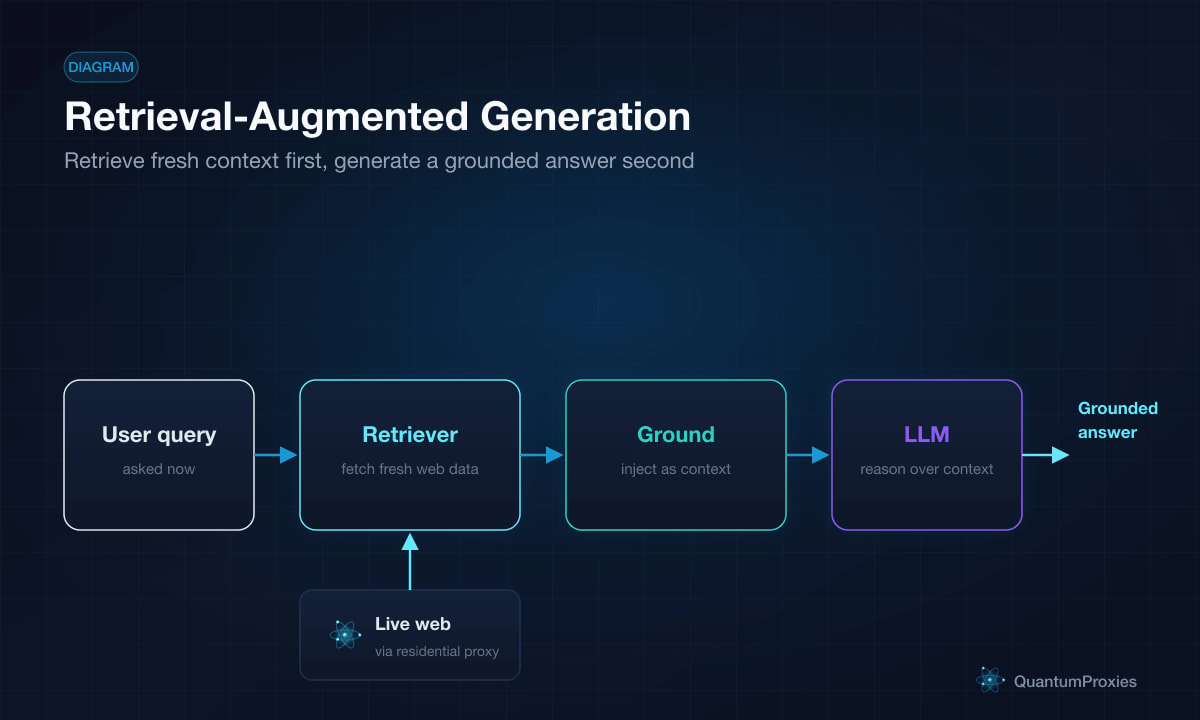
A model's parametric memory — what it learned during training — is frozen at its cutoff and compressed lossily into weights. It is excellent at language and reasoning and unreliable at specific, current facts. Retrieval-Augmented Generation (RAG) addresses this by separating the two jobs: a retrieval system fetches relevant, up-to-date documents at query time, and the model reasons over that supplied context instead of its frozen memory. Grounding the answer in retrieved text is how you cut the confident-but-wrong failures that no amount of prompt engineering can fully suppress.
The research literature is blunt about the catch, though. RAG only helps if the retrieved content is relevant and accurate. Feed the model stale, irrelevant, or contradictory documents and you do not fix hallucination — you launder it, giving a wrong answer the appearance of being sourced. One 2025 study calls the compounding effect "hallucination on hallucination": bad retrieval actively misleads generation. The quality of your data pipeline is not a detail. It is the whole game.
Fresh beats big
The instinct is to pour ever-larger static corpora into a vector database and call it knowledge. But a snapshot ages the moment it is taken. For anything that moves — prices, availability, news, rankings, reviews, documentation — the useful half-life of scraped data is measured in days or hours, not months. A smaller index that is refreshed continuously will out-answer a massive one that was built last quarter. The practical implication: your data layer needs to be a live pipeline, not a one-time dump.
- E-commerce assistants need current prices and stock, not last month's catalog.
- Market and competitive tools need pages as they exist today, including content rendered by JavaScript.
- Support and documentation bots need the latest version of the docs, not a cached fork.
- Research and monitoring agents need to pull sources on demand, mid-conversation.
The crawl economy is tightening
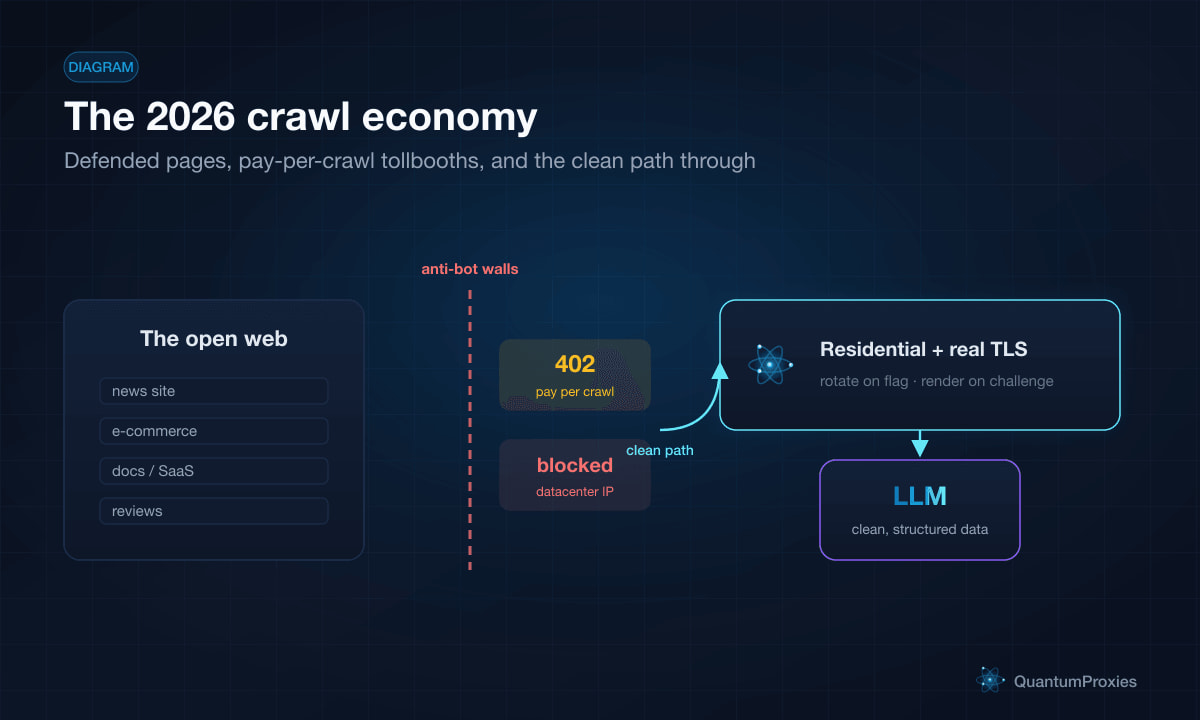
Collecting that fresh data got politically and technically harder in 2025. On July 1, Cloudflare began blocking AI crawlers by default for new domains and launched "pay per crawl," a system where a crawler either presents payment intent or receives an HTTP 402 Payment Required response. Publishers can now separate crawlers by purpose — search, AI agent, or training — and block or charge each independently. The open web is quietly growing tollbooths.
At the same time, a softer standard emerged from the other direction: llms.txt, a proposed convention — think robots.txt, but for LLMs — that lets sites publish a curated, machine-readable map of their most important content. Adoption has been rapid and grassroots, with tech-forward companies like Cloudflare, Anthropic, and Vercel among early adopters. It is not a ratified standard, and it does not grant access on its own, but it signals where the web is heading: explicit, structured channels for machine consumption sitting alongside an increasingly defended open web.
The takeaway for anyone building on web data is that naive crawling — a datacenter IP hammering pages with a default HTTP client — fails more often every month. It gets blocked, rate-limited, fed challenge pages, or served degraded content. Reliable collection now depends on looking like a legitimate visitor and handling the defenses gracefully.
What a good web-data-for-LLMs pipeline needs
Whether you are building RAG retrieval, refreshing a vector index, or giving an agent live access, the collection layer needs the same four properties.
Clean, model-ready output
LLMs reason best over clean text, not raw HTML full of nav bars, cookie banners, and script tags. Every extra token of boilerplate is context budget and money spent on noise. The pipeline should return Markdown or plain text with the main content already isolated — or structured JSON when you know the fields you want.
JavaScript rendering when needed
A large share of the modern web renders its real content client-side. A fetch that does not execute JavaScript sees an empty shell. But rendering every page in a browser is slow and costly, so the efficient approach tries a lightweight fetch first and escalates to a full render only when the page requires it.
Residential IPs with real fingerprints
To get through the tightening defenses without being throttled or blocked, requests should originate from residential IPs carrying a genuine browser's TLS fingerprint. When an exit gets flagged, rotating to a fresh one recovers the request. This is the difference between a pipeline that degrades gracefully and one that silently starts returning garbage.
Structured extraction on demand
Sometimes you want the whole page as Markdown; sometimes you want three specific fields as JSON. A pipeline that supports both CSS-selector extraction and natural-language (AI) extraction lets you shape data at the source, before it ever reaches your model, instead of post-processing messy pages downstream.
The pattern in practice
Rather than assembling browsers, proxy pools, and cleaners yourself, you send a URL and a desired shape to one endpoint. The QuantumProxies Extract API returns a page as clean Markdown by default and only spins up a headless browser when the page is challenged:
curl -X POST https://app.quantumproxies.io/api/v1/scraper/extract \
  -H "Authorization: Bearer qp_live_YOUR_KEY" \
  -H "Content-Type: application/json" \
  -d '{ "url": "https://example.com/product/123", "format": "markdown" }'
Need structured fields instead of a full page? Describe them in natural language and let the model shape the output for you — ideal for feeding a RAG index rows instead of documents:
curl -X POST https://app.quantumproxies.io/api/v1/scraper/ai \
  -H "Authorization: Bearer qp_live_YOUR_KEY" \
  -H "Content-Type: application/json" \
  -d '{ "task": "Extract product name, price, and availability", "url": "https://example.com/product/123" }'
Both requests run through rotating residential exits with real Chrome TLS fingerprints, so the pages that block ordinary bots come back clean. For agents that need to collect from many sources at once, the same platform exposes async batch and crawl endpoints — full documentation lives at https://quantumproxies.io/web-data-for-llms.
The takeaway
The models are not the bottleneck anymore — the data feeding them is. Grounding an LLM in fresh, clean, correctly-retrieved web content is the single most effective way to cut hallucination and keep answers current, but it only works if the collection layer is genuinely reliable. In a web that is adding anti-bot walls and pay-per-crawl tollbooths every month, reliable means residential, JavaScript-capable, and structured from the source. Get the data layer right and RAG does what it promises. Get it wrong and you are just hallucinating with extra steps.