Best Proxies for a Skyscanner Scraper: Multi-Source Fare Comparison
Skyscanner compares fares across many booking sources per search — which multiplies your scraper's request volume before you've even added routes or dates. Here's the proxy setup that keeps it reliable.
Skyscanner's edge is aggregation: a single search compares fares across a wide set of airlines and booking sources at once, so a user sees the cheapest option without checking each source individually. That aggregation is also what makes a Skyscanner scraper's request volume multiply fast — every route and date you track effectively fans out into several underlying lookups. Build that at any real scale and you have a high-volume collection job on your hands from day one.
The proxy strategy for Skyscanner is therefore less about a single trick and more about sustaining volume without ever looking like one operator hammering the site.
Why volume is the whole challenge
- Fan-out per search — each route/date query compares multiple sources internally, so your effective request count is a multiple of the routes you actually care about.
- Rate limits scale with pattern, not just count — a burst of similar-looking requests from one IP trips detection faster than the same volume spread naturally.
- Currency and market variance — the fares shown depend on the market the search appears to originate from, so multi-market coverage means multi-region requests.
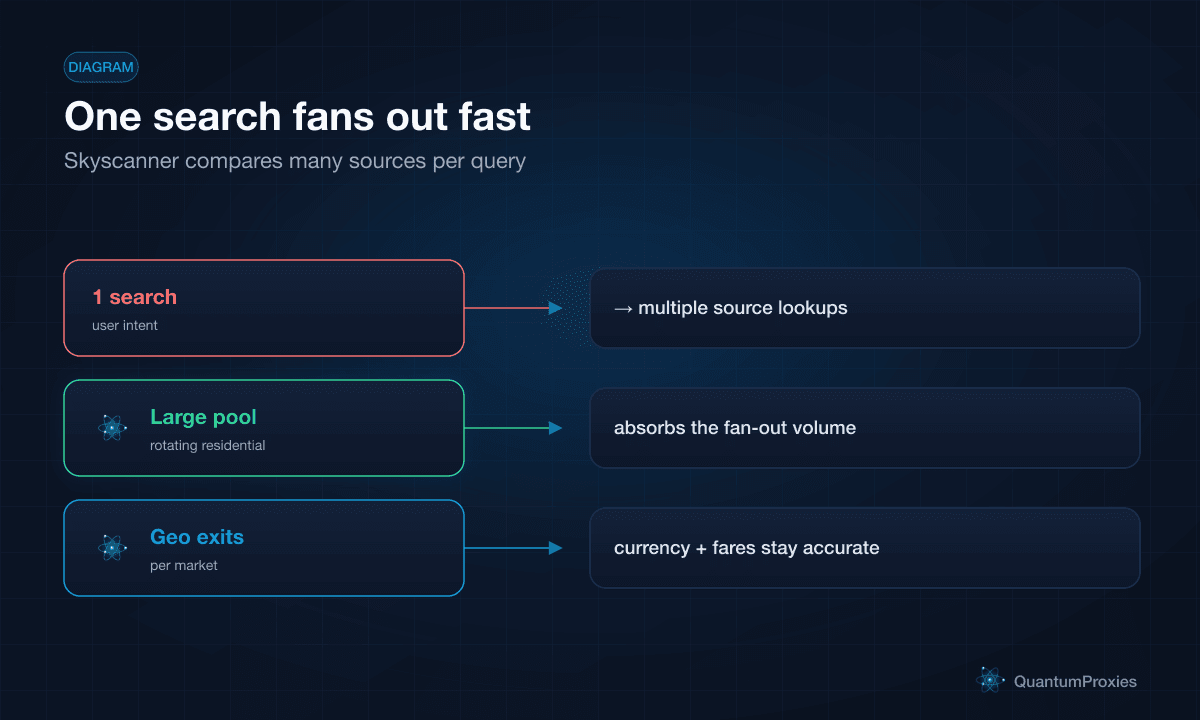
The proxy setup for sustained volume
- A large rotating residential pool — enough distinct IPs that your fan-out request volume never concentrates on any single address long enough to be flagged.
- Geo-targeted exits — matched to each market you're pricing, so fares and currency come back correctly for that region.
- Paced, distributed request patterns — spreading requests over time and across IPs, rather than bursting, keeps the traffic looking like many individual searches.
This is the same reason tools like Skyscanner's own Flight Scraper API on Apify and similar managed services exist — they absorb exactly this rotation-and-pacing problem so you don't have to rebuild it per project. The underlying requirement, a deep and reliable proxy pool, doesn't go away; it just gets handled for you.
How QuantumProxies fits
A Skyscanner scraper's fan-out volume is exactly what QuantumProxies' large residential pool is built to absorb, with city-level geo-targeting so multi-market fare comparisons stay accurate. Paired with the Scraper API for rendering and structured output, you get a reliable multi-source fare feed instead of a scraper that degrades the moment you add more routes.
Get proxies for multi-source fare scraping
Start with a free trial, spread your route and date coverage across a rotating pool, and keep a multi-source fare comparison actually comparing — instead of getting cut off before it finishes.