Ad Verification With Proxies: See Every Ad the Way Your Customers Do
Your ad looks perfect from your desk. But your desk is in one city, on one IP, seeing one version. Here is how media buyers use proxies to check how every ad really renders across regions, devices, and networks — and catch the fraud hiding in the gap.
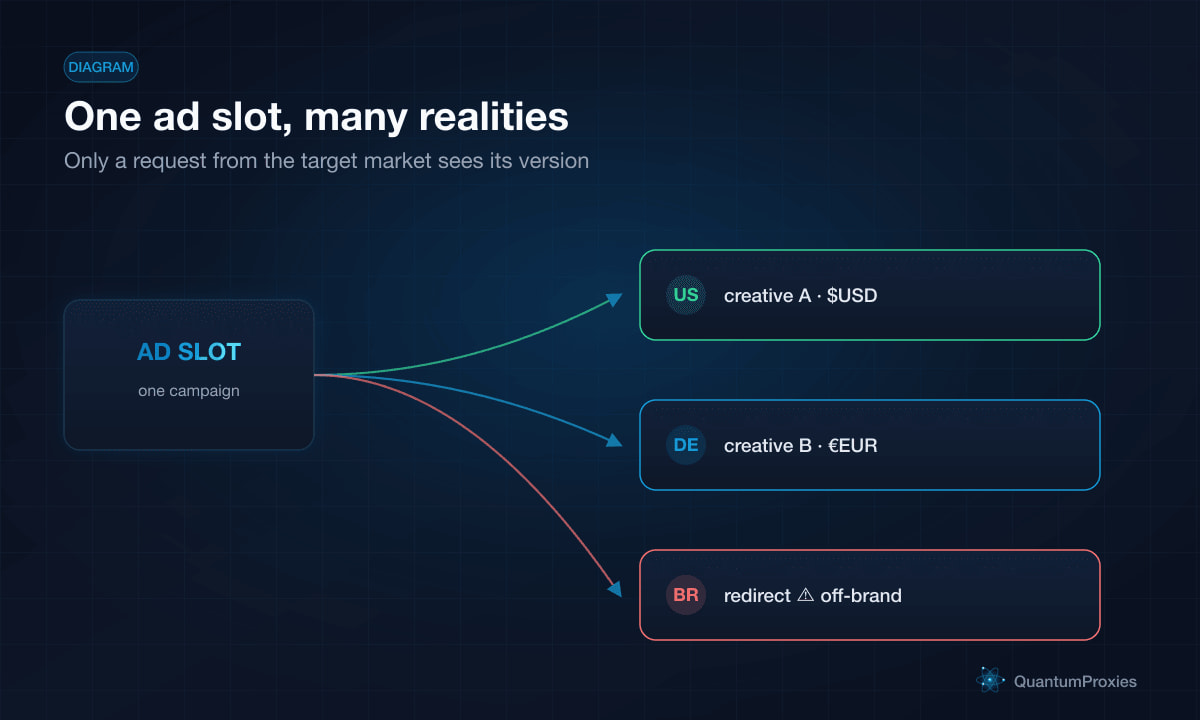
Here is an uncomfortable truth for anyone who buys media: the ad you approved is not necessarily the ad your audience is seeing. From your desk you see one version — served to your IP, your city, your device, your logged-in profile. The campaign you are actually paying for renders differently in Jakarta than in Chicago, on mobile than on desktop, on a fresh IP than on yours. Ad verification is the practice of closing that gap, and you cannot verify an ad you cannot see.
That is exactly where it gets hard. Geo-restrictions block you from region-specific placements. IP tracking and bot detection distort or block your view the moment you check at scale. And the fraud you are hunting — cloaking, misattribution, ads served where they were never authorized — is specifically designed to hide from the advertiser and show only to real users in the target geo. To catch it, you have to become one of those users, anywhere in the world, on demand. That is a proxy problem.
What ad verification is really checking
"Did my ad run?" is only the first question. A serious verification workflow answers four:
- Placement — did the ad appear where you paid for it, on the sites and in the positions the plan promised?
- Geo-accuracy — does the campaign render correctly in every target market, with the right creative, language, and landing page?
- Fraud and cloaking — is a partner showing one page to the ad network's reviewer and a different, worse page to real clicks?
- Brand safety — is your ad sitting next to content that damages the brand, or being spoofed by a lookalike creative you never made?
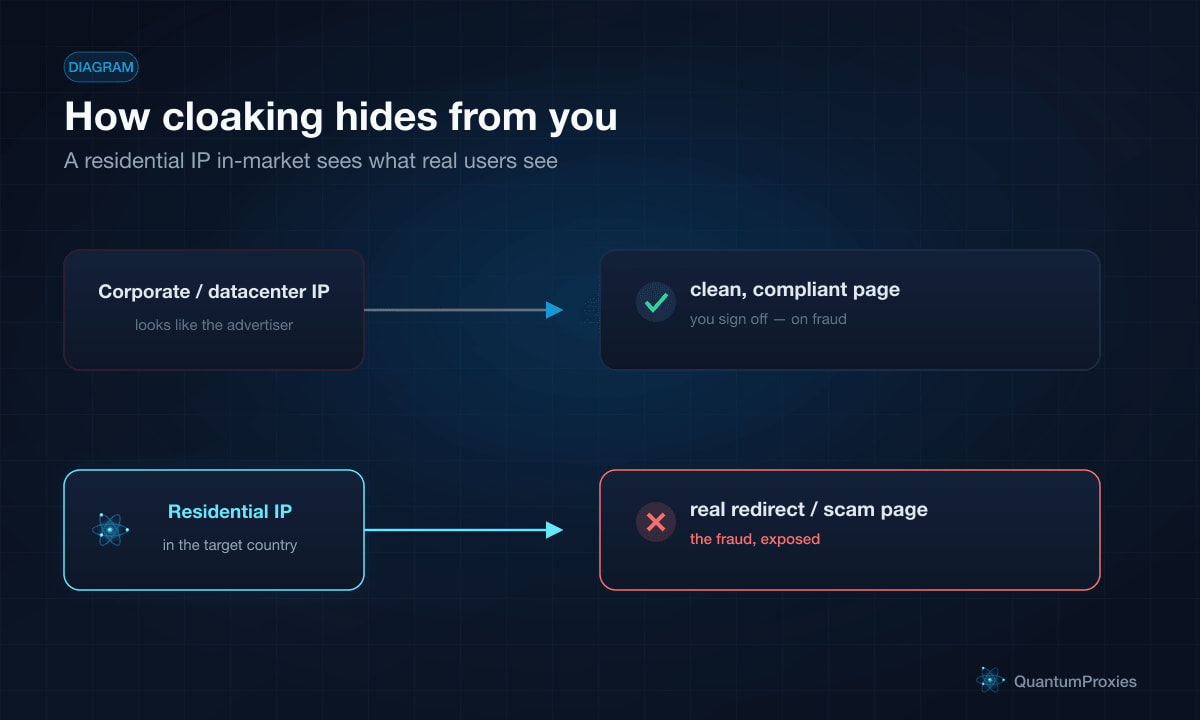
Cloaking deserves its own mention because it is the reason honest checking fails. A cloaked funnel detects that a request looks like the advertiser or the ad platform — same IP ranges, datacenter fingerprints, no real browsing history — and serves a clean, compliant page. Real users in the target country get the redirect, the scam, or the off-brand offer. If you verify from a corporate IP, you will see the clean version every time and sign off on fraud.
Why your own connection can't do this
Three limits make direct verification unreliable, and they compound:
You are stuck in one location
Geo-targeted campaigns only reveal themselves to viewers in the target geo. From a single office IP you simply cannot see the German, Brazilian, or Filipino version of your funnel — the ad network correctly decides you are not the audience.
You look like an advertiser, not a user
Datacenter and corporate IPs are the easiest thing in the world for a cloaked page or a fraud filter to recognize. The moment your traffic looks automated or non-residential, you get the safe version — which is exactly the version that is not defrauding you.
Checking at scale gets you flagged
Verifying hundreds of placements across dozens of markets means many requests from one source, and that pattern gets rate-limited and blocked fast — so your coverage collapses right when you need breadth.
How proxies let you see the real ad
Ad verification proxies solve this by letting you view ads as a real user would, from anywhere, at scale. The proxy type you pick decides how convincing that "real user" is:
- Residential proxies use real ISP-assigned home IPs, so cloaked funnels and fraud filters serve you the same version they serve genuine visitors. This is the backbone of honest verification.
- Mobile proxies route through real cellular IPs — the only reliable way to check how ads render for mobile users, and the hardest for fraud systems to filter out.
- Precise geo-targeting by country and city lets you stand in each target market and confirm the creative, language, and landing page are right where it counts.
- IP rotation lets you check thousands of placements without any single address tripping detection, so your coverage stays wide.
With that in place, the four checks become routine: bypass geo-restrictions to confirm placement in any region, simulate real users so cloaking cannot hide from you, switch IPs to monitor many campaigns and partners in parallel, and run continuous large-scale tests instead of occasional spot checks. Note that this is a legitimate, mainstream use of proxies — advertisers rely on it to confirm correct placement, protect budget, and prove campaigns reached the intended audience.
How QuantumProxies fits
Verifying ads is about authenticity and reach: you need IPs that look unmistakably like real users, in the exact places your campaigns run. QuantumProxies covers both — a large residential network with city-level targeting across 200+ countries for geo-accurate checks, and mobile proxies on real carrier IPs for verifying mobile placements and catching mobile ad fraud that desktop checks miss.
For teams running verification programmatically, the same network powers a Scraper API and SERP tools, so you can pull how an ad or search placement renders from any location in a single call and wire the results straight into your monitoring dashboards — no fleet of browsers to babysit.
See residential & mobile proxies for ad verification
Start a free trial, pick the markets your campaigns target, and check how your ads actually render where your customers are. The version you see from your desk is one of many — and the ones you cannot see from your desk are usually the ones costing you money.